




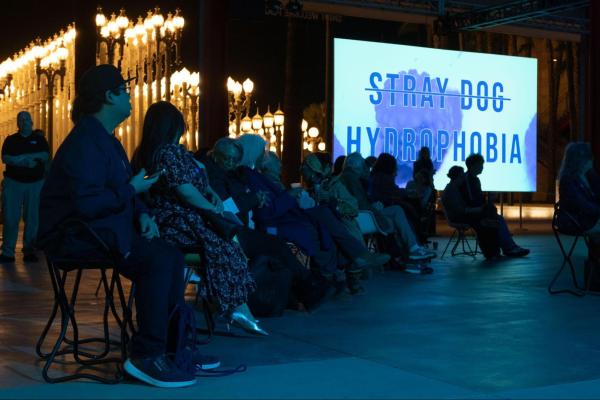
Earlier this month, LACMA hosted a special outdoor screening of Stray Dog Hydrophobia with a live performance, where Art + Technology Lab grant recipients Patty Chang and David Kelley presented their multidisciplinary film accompanied by a new composition from Yasna Yamaoka Vismale. Staged amid four surrounding projections and performed by a chorus of vocalists, percussionists, and horn players, the work immersed audiences in an oceanic world shaped by the intertwined histories of deep-sea mining, colonialism, slavery, and geoengineering. In the conversation that follows, Chang and Kelley speak with blue humanities scholar Elizabeth DeLoughrey about the cultural, political, and ecological questions underpinning the film.

Elizabeth DeLoughrey: The ocean has many meanings. It can be experienced as a place of origins, sustenance, play, and mobility, yet European colonial powers were more concerned with seeing the world ocean as aqua nullius (empty space), a blank backdrop to cross. This colonial logic was used to justify possession: if the world ocean is empty rather than culturally practiced, then no one can contest the universal claims on it by a colonial or military force. Due to the long history of transatlantic slavery, Caribbean cultural practitioners often represent the ocean as a space of mourning and memorial, a place of the ancestors, a practiced and even sacred space that complicates Western models of history and temporality.
I’m curious about how your film brings forward the ocean as a culturally practiced and historical place. One of the elements I found striking was your engagement with Derek Walcott’s poem, “The Sea is History.” In engaging the long history of transatlantic colonialism, Walcott turns to the ocean looking for ways to tell Caribbean history. Yet he concludes that the sea cannot be captured in language, but rather in the rhythm and sound. As filmmakers, does this resonate with your engagement with the ocean?
David Kelley: Yes, especially in relation to working with the Charlestown Maroon community in Jamaica and with Hawaiian activist Uncle Sol (Solomon Pili Kahoʻohalahala). Both became central characters in the film. Maroon culture carries an imaginary of resistance to colonialism, capitalism, and slavery. On our first trip to Kingston musicians from the Charlestown Maroons performed at a Greenpeace action outside of the Jamaica Conference Center where the International Seaboard Authority was meeting.
Patty Chang: These communities use song and music as resistance. Uncle Sol even sang to the delegates on the International Seabed Authority floor, normally a space of legal and technical language. His voice offered ceremony and welcome, infusing the gathering with different values and tonalities.
To me this was an intervention, an invitation to transform. Working with Yasna Vismale, our composer, and her performance with Bongo Herman (a musician who performed with Bob Marley) furthered this idea of sound as resistance and transformation. For the screening at LACMA, Yasna wrote a new composition that she performed live with nine musicians. Sound offers a completely different embodiment than legal language.

ED: Absolutely. A different vibration—literally.
DK: Because we cannot access the mining zone, we looked for stand-ins. We worked with artifacts from the 1692 Port Royal earthquake, salvaged from underwater, now housed in the National Museum of Jamaica. Their collection is a powerful analog, since Port Royal was a British port of piracy, slavery, and colonialism. The artifacts, frozen in time, can stand in for earlier media of extraction and exchange.
PC: In our film, a Fort Charles tour guide connects the earthquake and sinking of Port Royal in 1692 with the emergence of Kingston as Jamaica’s capital. It was a geological rupture that sank a world of trade. Seventeenth-century objects were submerged, excavated centuries later, and became analogs to the nodules themselves. Pitchers, candlesticks, vials, bowls, combs, cannonballs and jewelry boxes are some of the artifacts we scanned and animate in the film. They float through the ocean, reactivated, and gain a spiritual presence. History is still active in the water.
ED: This suggests another way in which the sea is history, an embodied place. If we take this even further, we can consider the minerality of the ocean, which is what the major mining companies seek to extract from the sea floor. The sea is history, as well as minerality. That’s something that we share in the carbon and minerals that make up our bones. Recognizing our embodiment is to be part of that mineralization. Was this part of your thinking in the representation of polymetallic nodules? You have some interesting representation of potatoes “swimming” through the water.

PC: Yes. The potatoes came from early descriptions of polymetallic nodules being “harvested,” like “fields of potatoes” on the seafloor. Shark teeth fell, and over millions of years minerals in the water attached, forming potato-sized nodules. A body part becomes mineral, becomes energy. The cucumbers in the film were a play on this: how trade language labels an animal a vegetable, like the “sea cucumber.”
It felt right because Jamaican markets overflow with root vegetables: taro, yucca, turmeric, ginger, cassava. We bought them in the markets, wrote on them or animated them as the camera moved through spaces like the ISA and underwater.
ED: This is vital because provision grounds—plots in the mountains given to enslaved people where sugarcane couldn’t grow—produced yams, cassava, and plantains. These were vital spaces of sustenance and independence. Many enslaved people even bought their freedom from selling what they grew in the “underground.” I love that these staples become alternative ways of telling the story of extraction.
The British didn’t know how to grow crops in the tropics, but Africans and Indigenous people did. These provisions sustained the population and supported Maroon communities in Jamaica’s mountainous terrain, shaping resistance. These “hidden” foods, like ground provisions, are the submerged story of the Caribbean. And that turn to submerged stories seems to be an integral part of your excavation work here, whether it’s about sunken colonial artifacts, submarine histories of migration, or the modern extraction of seabed minerals. Making these connections visible is important work for the visual arts.

DK: Yes, and maybe this brings us back to the seabed via the Black Atlantic and how sadly global its commodification is. In our film, Uncle Sol talks about his battle to question this idea of intangible underwater cultural artifacts, which in the context of the Clarion Clipperton mining zone and the ISA is human remains, wrecks of boats, and industrial infrastructure. He brings in his Hawaiian Indigenous perspective and the notion of the evolution starting with the coral polyp. That was, for me, the aha moment that brought our film into the space of intangible underwater cultural heritage, oral traditions, Indigenous knowledge, and their contrast with logics of capitalism and colonialism.
The Art + Technology Lab is presented by

The Art + Technology Lab is made possible by Snap Inc.
The Lab is part of The Hyundai Project: Art + Technology at LACMA, a joint initiative between Hyundai Motor Company and LACMA exploring the convergence of art and technology since 2015.