




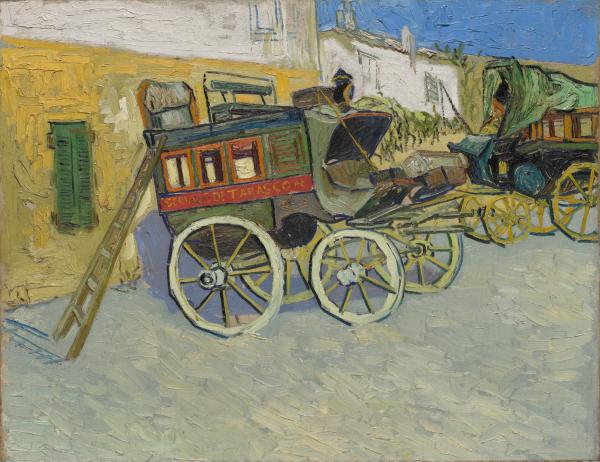
As LACMA prepares for the 2026 public opening of the new David Geffen Galleries, the future home of the museum’s permanent collection spanning a breadth of eras and cultures, we’re sharing 50 iconic artworks that will be on view in the building over the next 50 weeks in the series 50 Works 50 Weeks.
“I’ve just painted that red and green carriage in the yard of the inn. You’ll see. Simple foreground of grey sand. Background very simple too, pink and yellow walls with windows with green louvered shutters, corner of blue sky. The two carriages very colorful green, red, wheels yellow, black, blue, orange. A no. 30 canvas once again.” This description of Tarascon Stagecoach was captured both in words and in a beautifully illustrated sketch in a letter written by the painter Vincent van Gogh to his brother, Theo, on October 13, 1888. At this time in Van Gogh’s brief but prolific career, the Dutch painter had moved from Paris to the town of Arles, in the south of France and near the Mediterranean coast, seeking a more temperate climate and more relaxed atmosphere than the French capital offered.
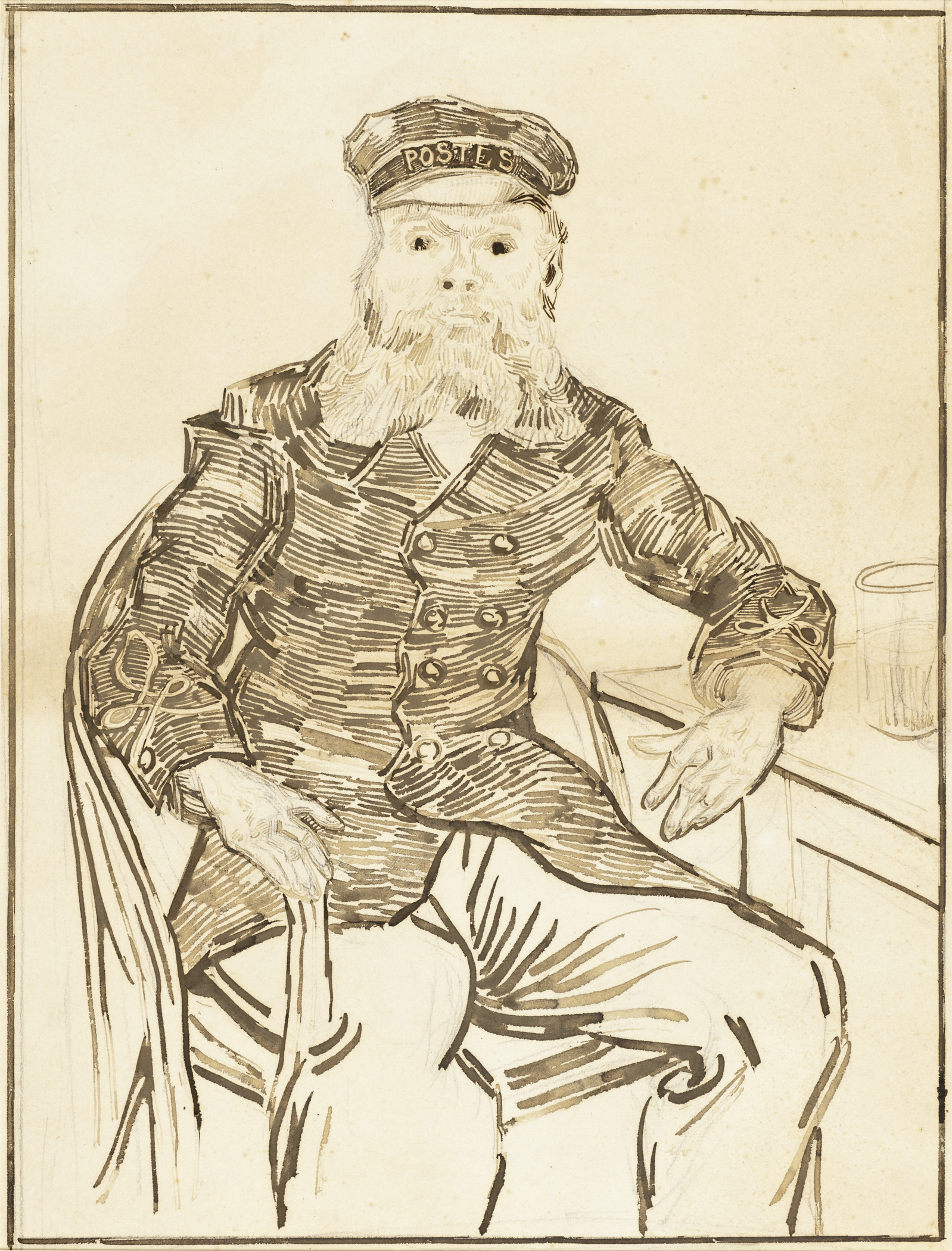
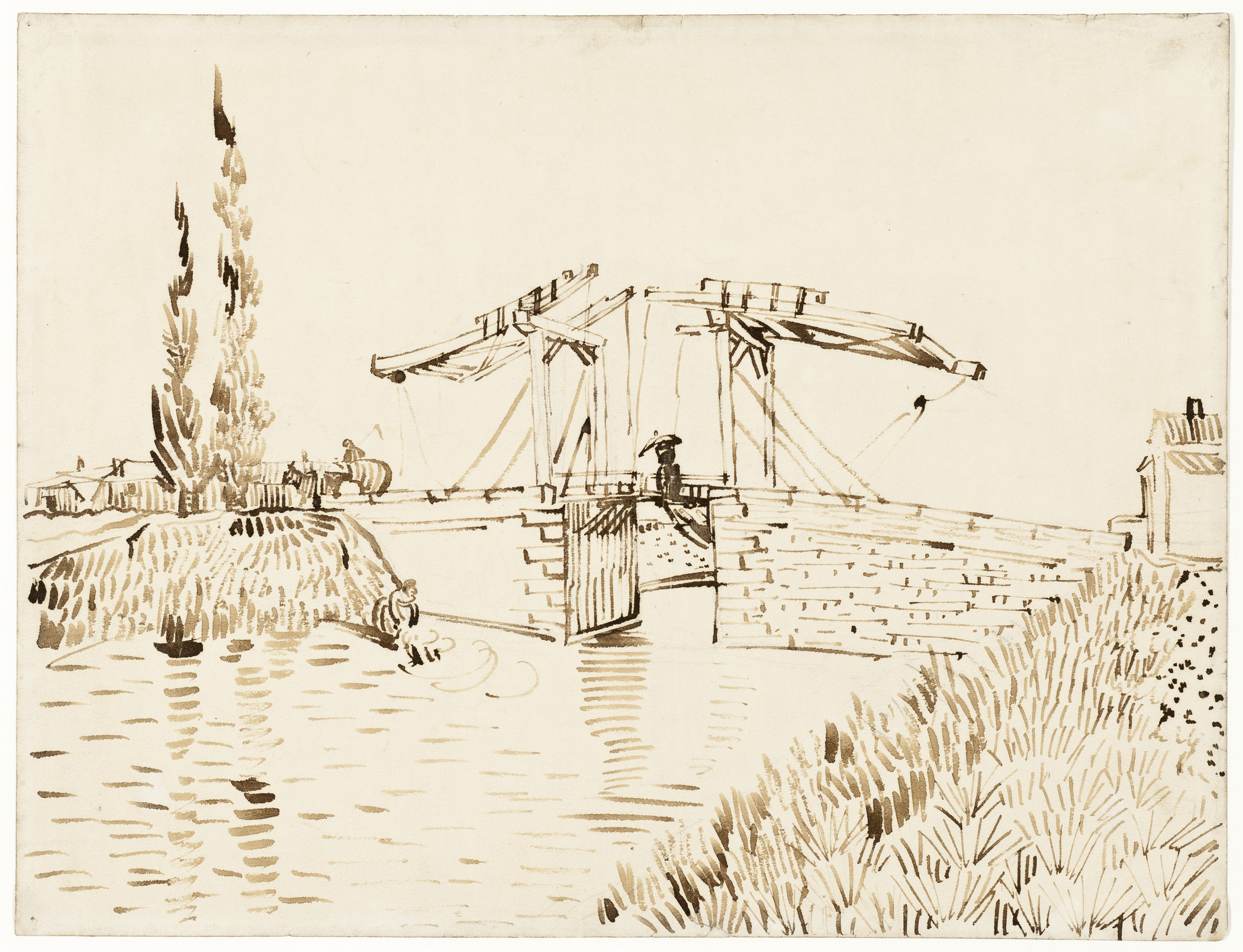
Van Gogh settled in the south in February of 1888, and it was here where he painted some of his most iconic pictures. Van Gogh’s paintings of sunflowers and portraits of the Roulin family were made during this period, as were both of LACMA’s magnificent drawings, The Langlois Bridge, about May 1888, and the portrait of The Postman, Joseph Roulin, drawn just around the time of the Tarascon Stagecoach, in early October. At the time the artist was capturing his surroundings in pen and ink, as in these drawings and his letters, he was exploring an ever thicker deployment of oil and pigment in his paintings, with an increasing interest in the symbolic expression of color.
It was also during this time while living in Arles, where his compositions capture his reflections on the changing ways of his contemporary world. This painting, essentially a portrait of a stagecoach, presents Van Gogh’s nostalgia for a simpler, and slowly vanishing, way of life. By 1888, the Tarascon stagecoach was long an outmoded method of transportation that had a decade earlier been replaced by the railroad between Paris, Lyon and Marseille. At this time, this stagecoach would have served to connect only the small villages remaining off the railway lines.
Tarascon Stagecoach is the first painting by Van Gogh to enter LACMA’s collection, and is currently on view in Village Square: Gifts of Modern Art from the Pearlman Collection to the Brooklyn Museum, LACMA, and MoMA (in the Resnick Pavilion through July 5, 2026).