




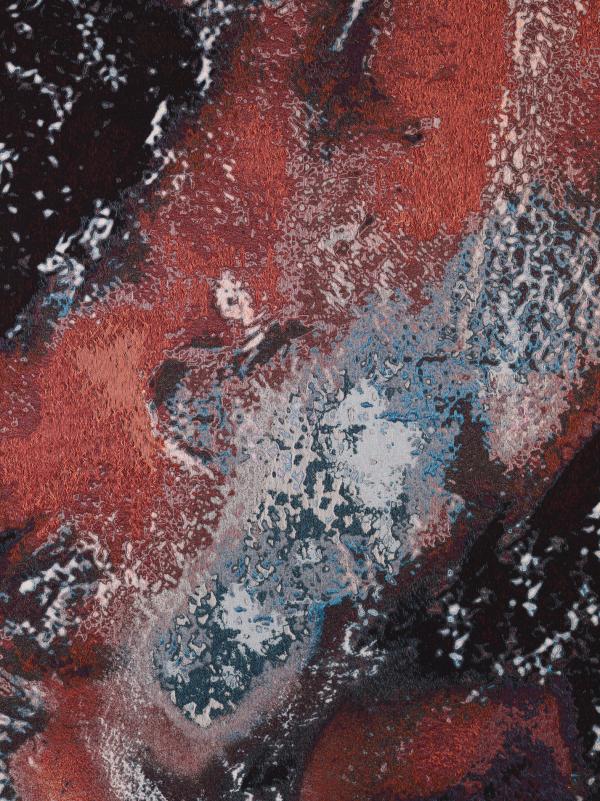
As LACMA prepares for the 2026 public opening of the new David Geffen Galleries, the future home of the museum’s permanent collection spanning a breadth of eras and cultures, we’re sharing 50 iconic artworks that will be on view in the building over the next 50 weeks in the series 50 Works 50 Weeks.
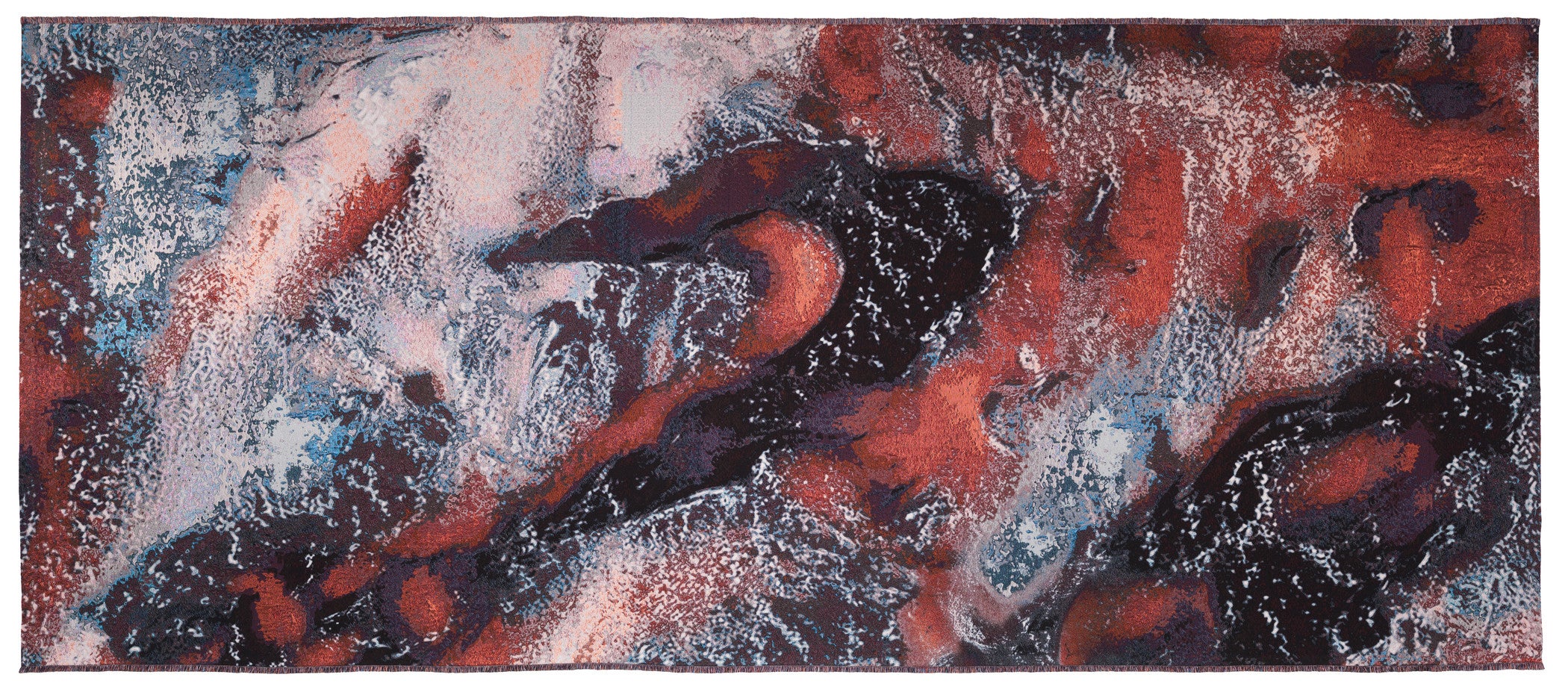
We recently had the opportunity to speak to artist Sarah Rosalena about her monumental textile work Threading the Infinite: Omnidirectional Terrain (2025), which will be housed in one of the building’s ground-level spaces.
Could you tell us a bit about the piece?
Threading the Infinite: Omnidirectional Terrain is really a textile that points to land and cosmos in a lot of different directions. And a lot of that also is a way to look at weaving and how it operates in its origin, because it is something that is 3D—threads go over and under, up and down, soaring, hovering over spaces. So in many ways it almost resembles a terrain. As a handweaver who's very interested in examining textile from digital media, I really wanted to make a work that really invoked the terrain, but that also put land and cosmos in all these different directions. For visualizing space, gazing at the cosmos or looking above means to be grounded on Earth, and there's an exchange between transmitting and receiving from above and below, of threads going up and down, over and under, and visualizing a planet. When looking at the work, there are no directions, there's no compass, therefore no boundaries or borders. It is, in woven form, an attempt to break geospatial edges because it has its own form of layers and strata, of different sediment and minerals.
Where did that initial idea come from?
A lot comes from my interest in the origin, characteristics, and structure of weaving. It is three dimensional, and it really pushes against the digital flatness and smoothing of images. I'm really inspired by things that are celestial, things that are otherworldly, planetary. And here it's really like poking at different ways of seeing things. You can almost see woven mountains or valleys or atmosphere or water. It's created by looking at images of land from above, while at the same time distorting the extractive technologies that render it possible.
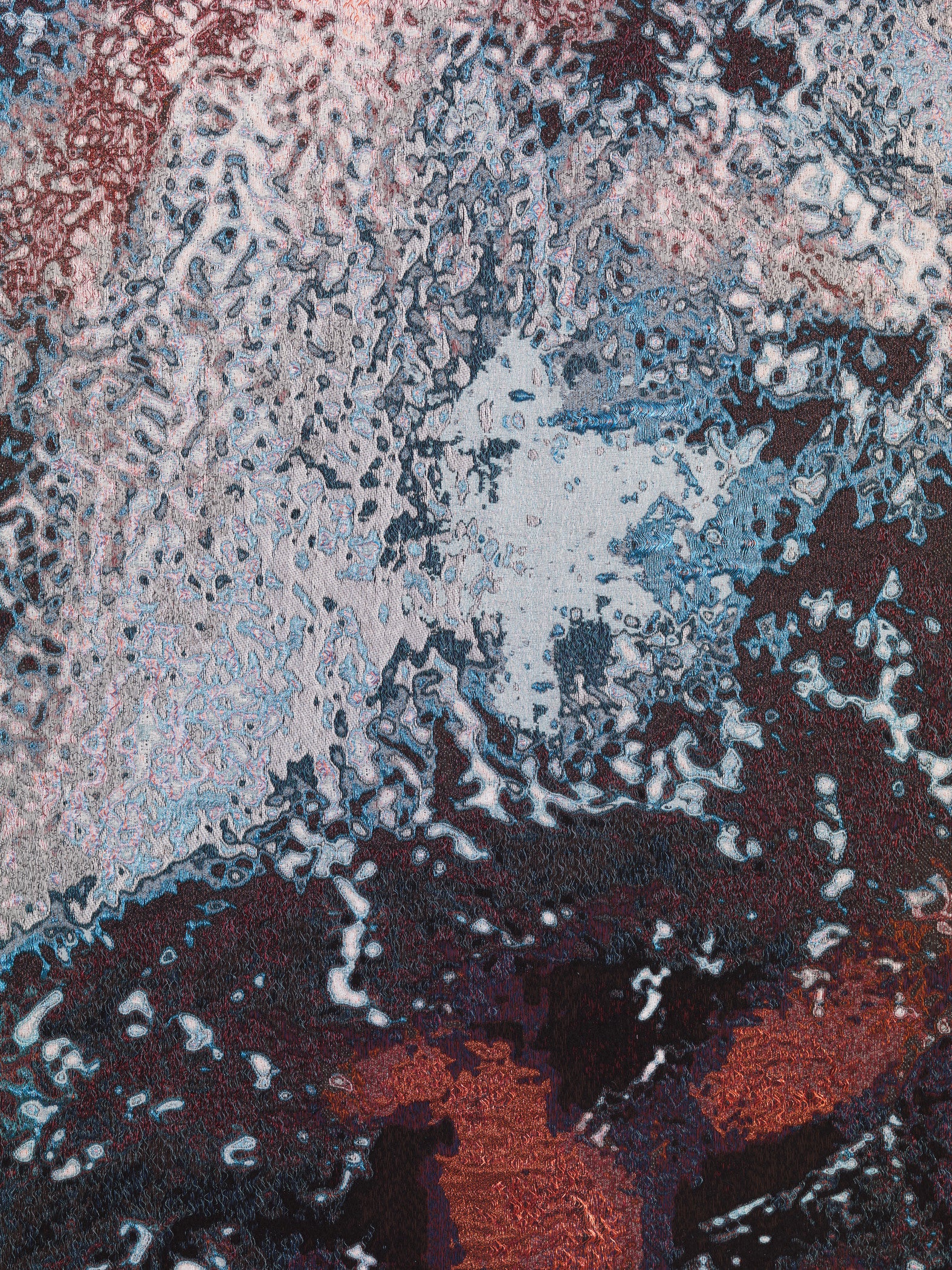
In my weaving practice, I embed a lot of distortion, error, and material resistance, through loosened handwoven and computer-aided weave patterns, noise, and shimmer, that challenge the woven nature that is possible in textiles. For example, this work has been in process for over six years, combining over 12,000 warp threads and 12 colors of yarn to create hundreds of different combinations. I combined fluffy mohair to hover over yarns to evoke atmosphere, as well as glitching shiny viscose as otherworldly peaks and valleys. And I see it almost as a woven refusal, because it becomes this generative force that's pushing against traditional boundaries to create new possibilities for understanding the interconnectedness of us, of the cosmos, materials, and knowledge.
Could you tell us a bit more about the concepts behind the work?
The work is really a commentary on technology and what it means to be making work with technology at a time of with the rise of climate change, violence due to borders, future colonization. So here it's really a way to point back at us, to see how we understand land, understand terrain, understand Earth, future Earths. So much of this work is about speaking to power and how we think about land, visualizing land in multiple directions—thinking about Earth, weather, climate change, colonialism, and all the extractive technologies that are involved in how we see and understand land.
This work becomes a disruption. It really challenges the grid and these older cosmologies. I grew up in Los Angeles and was exposed to technology, learning textiles from my mother and grandmother and master weavers across the Southwest. I grew up with a very traditional weaving background, but my grandfather also worked for the Jet Propulsion Laboratory. I've always been very interested in the technologies that have made Los Angeles what it is today. I've been working with the LACMA Art + Tech Lab since 2019, and this textile is really a result of many years of being in conversation about how textiles could operate as a form of disruption to the otherworldly in power: who visualizes, sees, names, and carries land, whether it's humans, non-humans, life, or death, and Earth becoming terraformed or us having to leave Earth. It is about life and non-life, but at the same time, thinking of it in terms of an infinite planetary landscape. It's really like playing within the imaginary. You can see it as oceanic, but also desert at the same time. Its position in the space, having to gaze upward, is also an act in itself, of thinking of something that is above and that also links back to the materiality of the weaving—looking up, looking down, over and under.
What was the process of actually creating this work like?
First and foremost, I am a weaver. I weave on a variety of different looms, manual hand looms, bead looms, and floor looms, as well as manual digital Jacquard looms or fully mechanized looms. I wanted this piece to be very expansive and large, and so this was quite a challenge for me because I really had to really think differently in terms of scale when designing the work. Many of my textiles start off on weave draft paper, then transferred into a digital file in Photoshop, where everything is represented by black and white pixels, indicating a thread going up or down. This work has been kind of a collage of weaving patterns from many different landscapes that I've done over the years, exploring terrains, some that have been made early in 2018, 2019, with GANs of Mars and Earth. It became a way to challenge myself and make this larger terrain and experiment with different colors, shades, and textures. There are over 12 different kinds of yarn in the work, and to do something at this scale required a tremendous amount of sampling and really seeing how the different colors and yarns would interact with each other, which ones would hover more over others, and which ones would glisten in the space. I really wanted it to resemble something otherworldly, and that would add to the space and grab attention from its position, since it is installed higher in the space with natural light.
Were there any challenges?
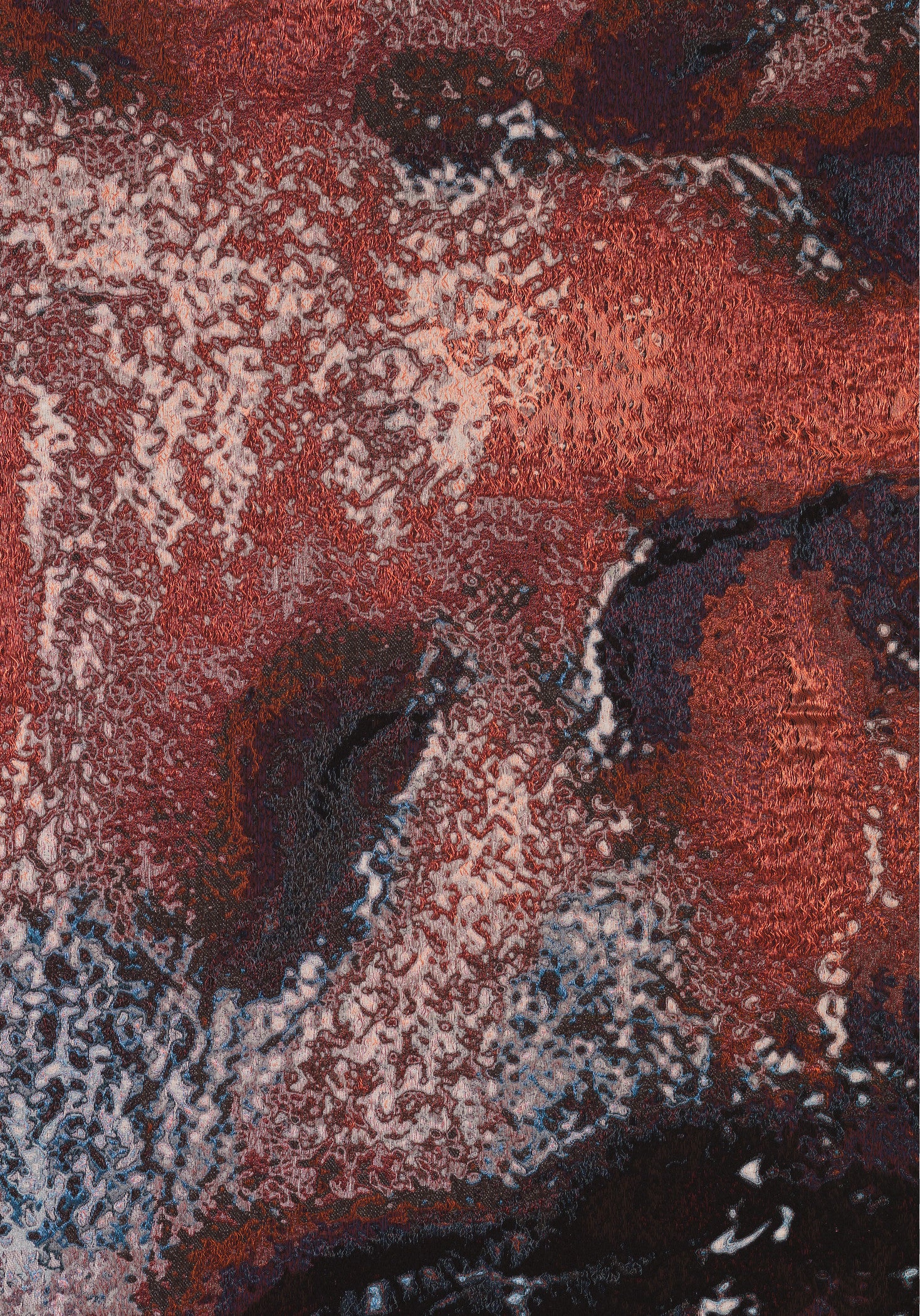
To do work at this scale was a huge challenge. Not just in terms of designing a weave pattern for 27 feet and all the different color combinations and how it was going to lie, but also the disruption in the errors and designing alternative bitmaps, which I use as complex weave patterns—advanced multi-layer structures—in order to weave the work. For example, this work was woven after rigorous sampling on a very large industrial digital Jacquard loom using a library of handweaving patterns I’ve made throughout my career. It was really pushing not only the technology and the conception of being this infinite work about land and cosmos, but also pushing the unlimited possibilities of the loom going over and under, up and down. It has a very organic look—it could almost be a storm cloud or an ocean or a desert. You can see swirls in it. Some colors are floating more than others. And this work will continue to shift over time as threads begin to relax, changing color in the space over time.
The work isn’t installed in a typical gallery space, and is placed quite high up. What would you like people to get out of their encounter with it?
What I want people to get when looking up at the work is to imagine the boundaryless, the borderless, what it means to put land and cosmos in all directions. There's an exchange between transmitting and receiving from above, below, weaving over and under. And what it means to visualize a planet, think of a planet, and what that means for our future.