




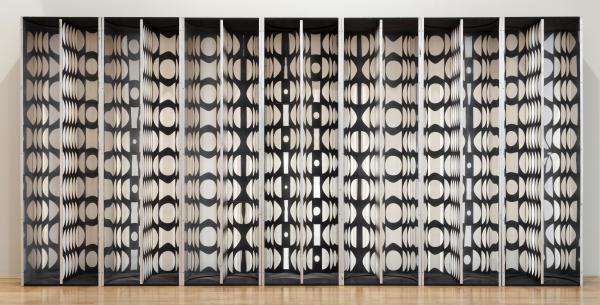
Over the years, I’ve been gradually building our collection of Latin American art from the 1960s—a time marked by political instability and turmoil but also a boundless sense of optimism and experimentation. Julio Le Parc’s work was at the very top of my list, and in 2013 I happily succeeded in acquiring Mural: Virtual Circles for LACMA. This beloved interactive work is now on view in our new David Geffen Galleries.
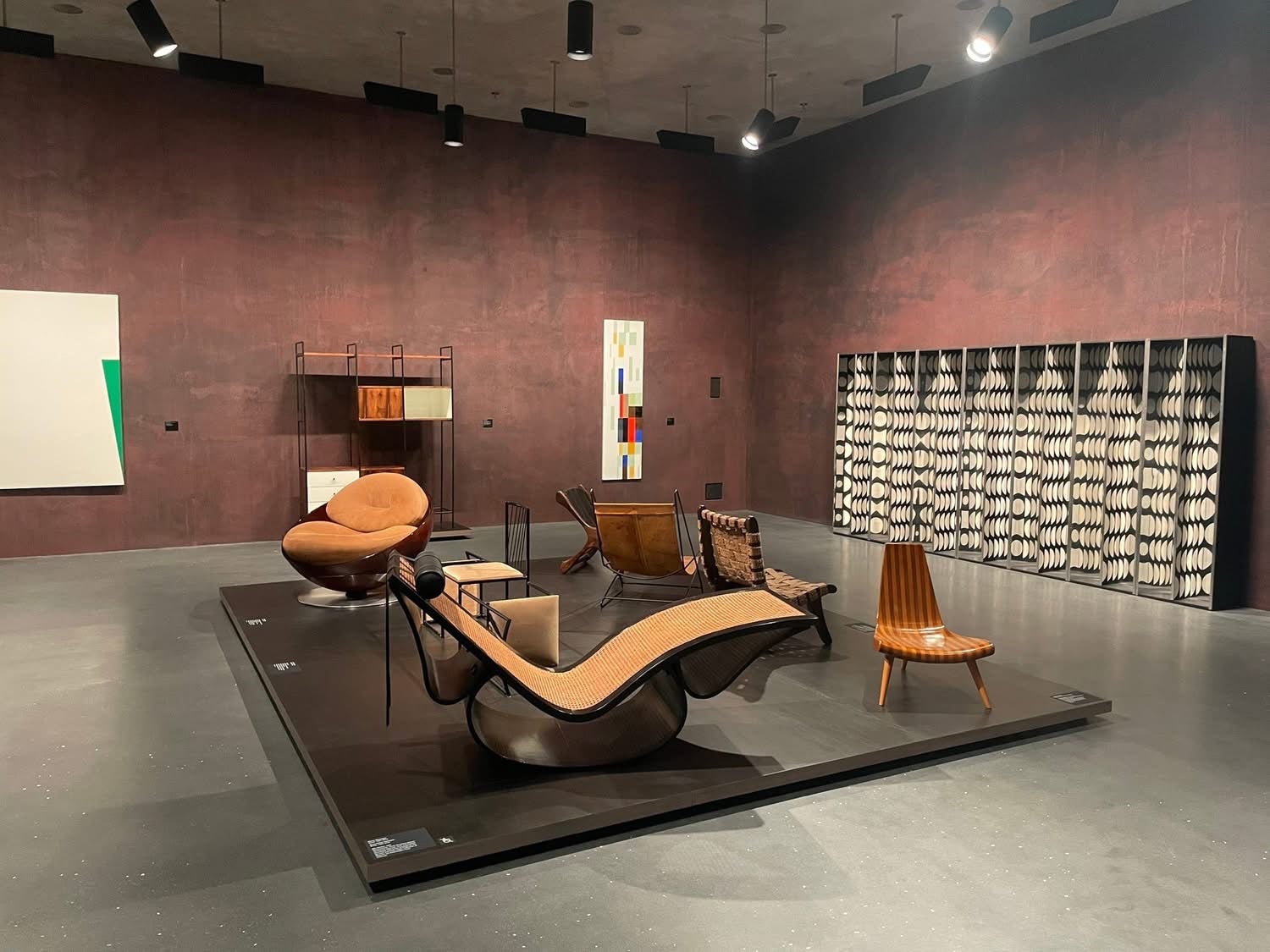
Seen from the front, it is deceptively static but becomes fully activated with just the slightest shift in the viewer’s position. The construction is surprisingly plain: it consists of seven wood boxes with patterned laminate placed on the interiors, which is then distortedly reflected onto curved sheets of polished metal. Despite its simplicity, the work is visually complex and almost scientific in its conception.
Born in Mendoza, Argentina, to a humble working-class family, Le Parc moved to Paris in 1958, where he was a major member of the op and kinetic art movement. In 1960, he co-founded the Groupe de Recherche d’Art Visuel (GRAV), a laboratory of collaborative artistic experimentation. The group’s goal was to break from traditional art that turned viewers into passive observers. They created playful, participatory works that destabilized the audience’s perceptions and promoted a more democratic way of experiencing art—what Le Parc called a “plastic kinetic adventure.”
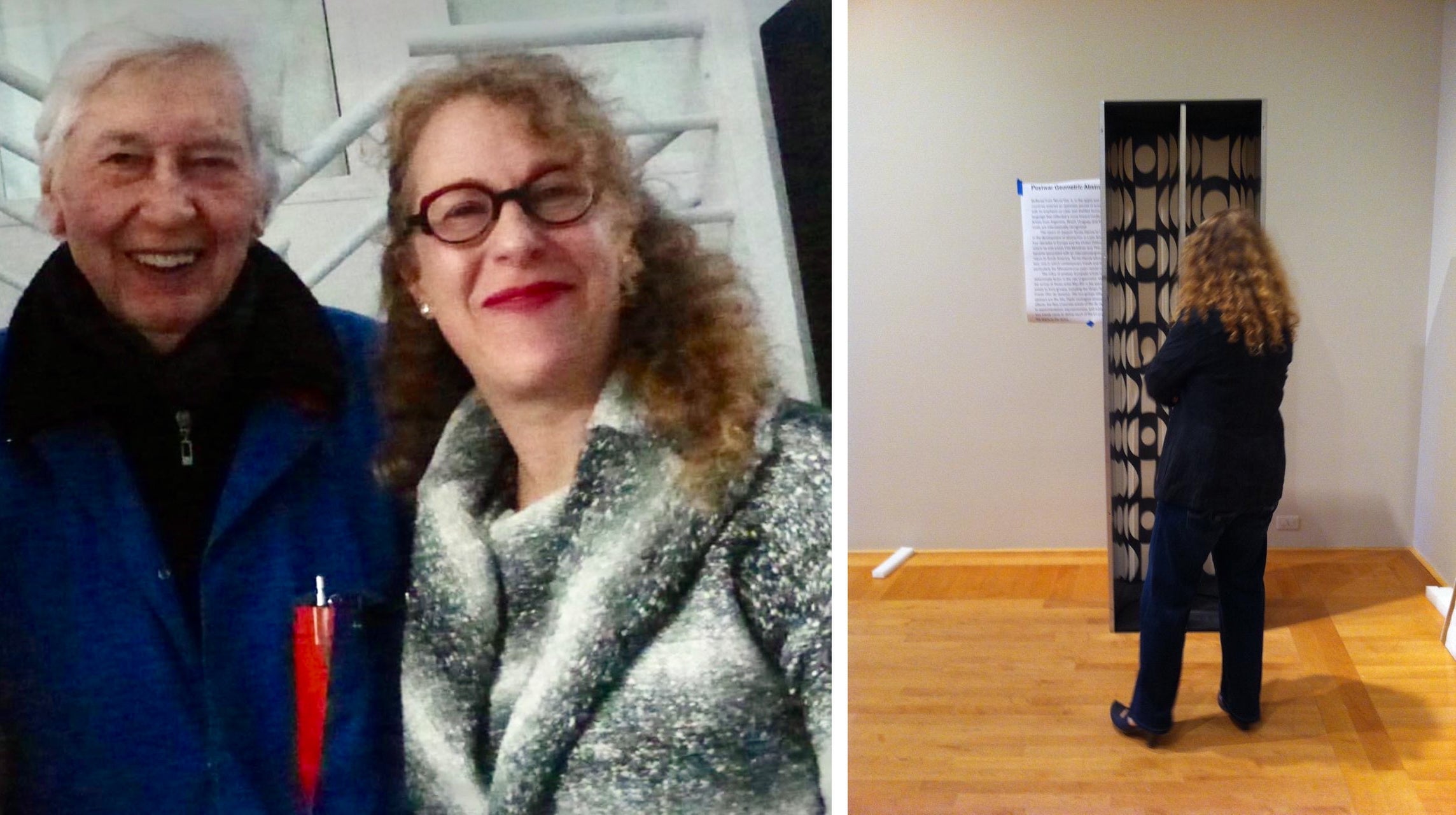
A year after I acquired Mural: Virtual Circles, I traveled to Cachan, just outside Paris, to visit Le Parc. His son, Yamil, warmly picked me up at the train station and brought me in through a scintillating dark room filled with luminous kinetic works. From there we proceeded to the home-studio: a bright space covered with large mood-lifting works painted the colors of the rainbow. Le Parc came down dressed in his signature blue overalls and lab coat. When he found out I was from Mexico, he mischievously brought out a bottle of tequila, and we talked about this and that while touring his enormous workspace. We had a great time. He was as optimistic as he was incisive, and generously fielded all my impertinent questions, including whether he considered himself more a European or Latin American artist, to which he wryly responded that he was both.
For him, whether his work was presented within the context of Europe or Latin America was irrelevant because any work could be shown in myriad contexts; what mattered was that it be shared and enjoyed by everyone. In this sense it’s instructive to remember that throughout his life and career, Le Parc maintained one foot in Latin America, where he frequently traveled and exhibited his work, and that when he went on to win, with great fanfare, the International Grand Prize for Painting at the 1966 Venice Biennial, he represented Argentina, not France. I found Le Parc’s lack of concern with such divisions refreshing, especially in light of recalcitrant efforts to pigeonhole artists into myopic categories that are more exclusive than inclusive.
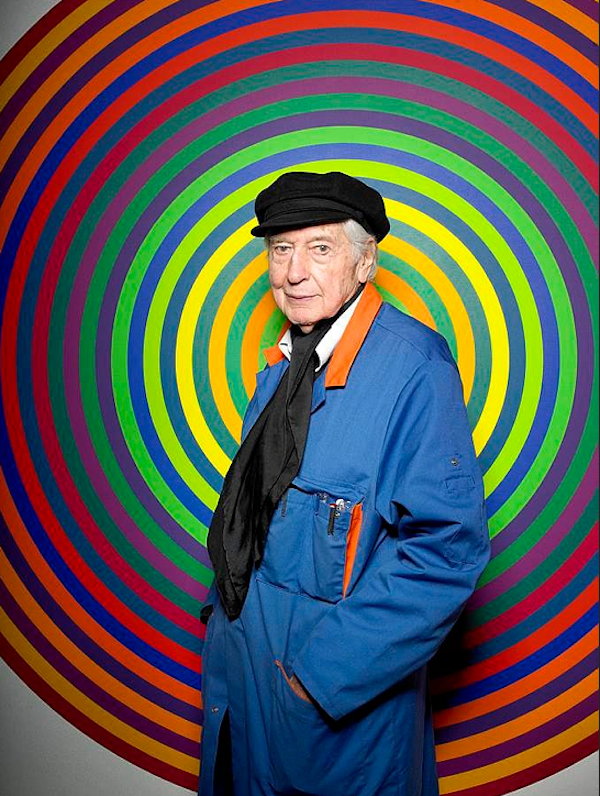
Mural: Virtual Circles was created during the heyday of GRAV’s formal investigations, two years before the group disbanded in 1968. It was exhibited by the celebrated art dealer Denise René (1913–2012) in 1968. Le Parc’s playful yet exacting work brilliantly mirrors his own personality. His blue overalls and lab coat were clearly much more than protective garments: they symbolized that art-making is a form of work like any other (not an elitist activity), and that a good work ethic is the path to all forms of creativity. He belonged to a generation that considered the viewer part of the artwork—not separate from it—and that strove to demystify the idea of the artist as a solitary genius. Ahead of his time in more ways than one, he never stopped experimenting.