




As LACMA prepares for the 2026 public opening of the new David Geffen Galleries, the future home of the museum’s permanent collection spanning a breadth of eras and cultures, we’re sharing 50 iconic artworks that will be on view in the building over the next 50 weeks in the series 50 Works 50 Weeks.
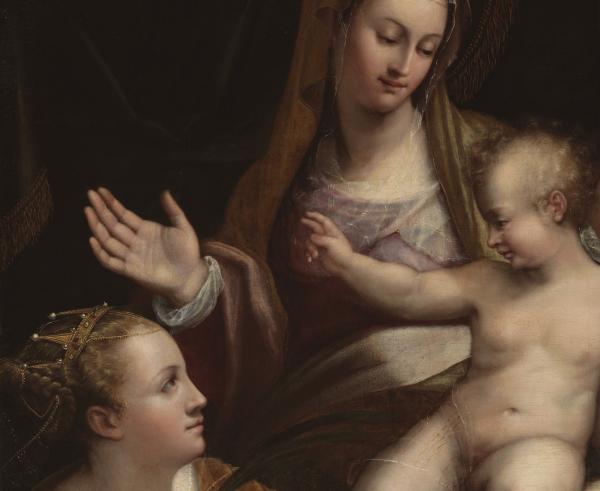
Renowned as a popular portraitist and religious painter, Lavinia Fontana’s meticulous representation of textiles reflects her access to local nobility in Bologna, capturing the splendor of Bolognese fashions, including gold stitching, lacy flourish, beaded designs, and fine jewelry. Consider the translucent veil cascading on this Madonna, whose arms outstretched in the prayerful orante pose, gazing downward at the infant Christ. An intricate jewel- and pearl-encrusted crown adorns the kneeling Saint Catherine, who receives the infant’s blessing. She wears a ring that symbolizes her mystical marriage to Christ and holds the spiked wheel emblematic of her martyrdom. This impressive rendition of the Holy Family was likely commissioned for a family’s private chapel. The infant’s proximity to the picture plane draws the devout beholder’s attention, creating an intimate connection. By 1604, Fontana’s fame was widespread across the Italian peninsula. Pope Clement VIII summoned the artist to Rome, where she became the favored artist of Roman and Bolognese aristocrats.
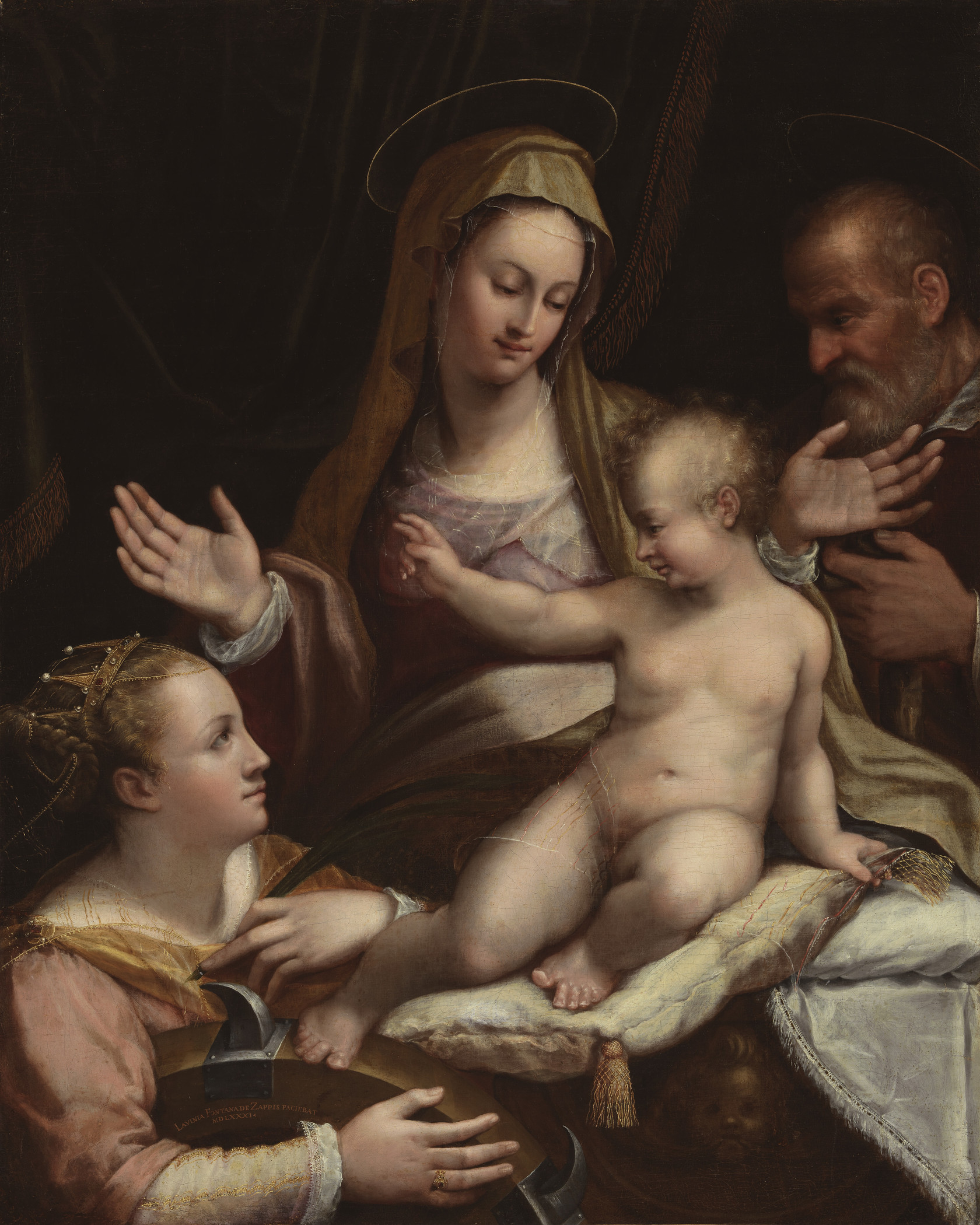
Fontana’s devotional paintings were informed by contemporary investments in religious imagery, local to Bologna. Prior to establishing her own practice, Fontana apprenticed with her father, who was closely associated with the religious and artistic principles of Cardinal Paleotti. Paleotti advocated for religious paintings that emphasized clarity and inspired devotion, a significant departure from artworks that favored sensual distortions of the figure and visually complex compositions. Fontana’s compositional clarity suggests her adherence to Paleotti’s treatise, Discourse on Sacred and Profane Images (1592), in which he elucidated the clarity and simplicity mandated by the Council of Trent for religious images.