




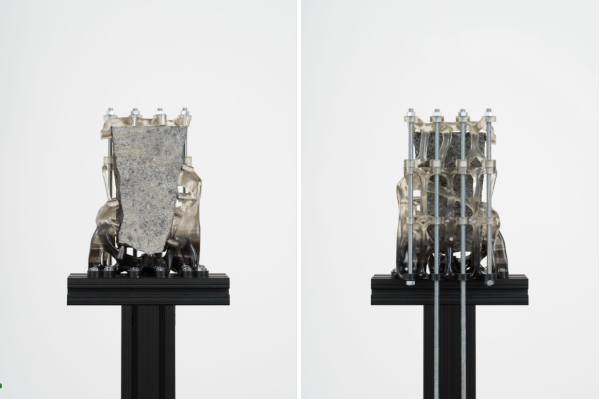
Los Angeles is a city that feels in many ways to be still in the process of creation. To live here is to embrace a perpetual state of transition, a city that moves from demolition to rebirth and back to demolition again, where preservation is an exception rather than the rule. Within this cycle of reinvention, the museum becomes a key tool in preservation, defining the ways society understands culture, technology, and history. In response to this structural authority, artists have started analyzing material histories and interrogating the institutions that create their framing.
Cayetano Ferrer is a Los Angeles–based artist interested in the ways in which history, memory, and design intersect. His concerns center in on the relationship between the arts institution, architecture, and artwork itself. For the past decade, he has worked in collaboration with LACMA's Art + Technology Lab to expand his inquiry of institutional histories through his project Object Prosthetics, a series of case studies examining LACMA's architectural archive. Beginning in collections research and exhibition spaces, the study evolved into a display of the corporeal quality of the museum’s historic campus and the authorial choices made by LACMA. By integrating techniques in 2D/3D scanning and 3D fabrication, Ferrer illuminates the tension between the museum and the reconstruction of memory.
We recently had the opportunity to speak with Ferrer about the project, the conceptual grounding for his work, and how he experiments with material culture to highlight the fictions within museum infrastructure.
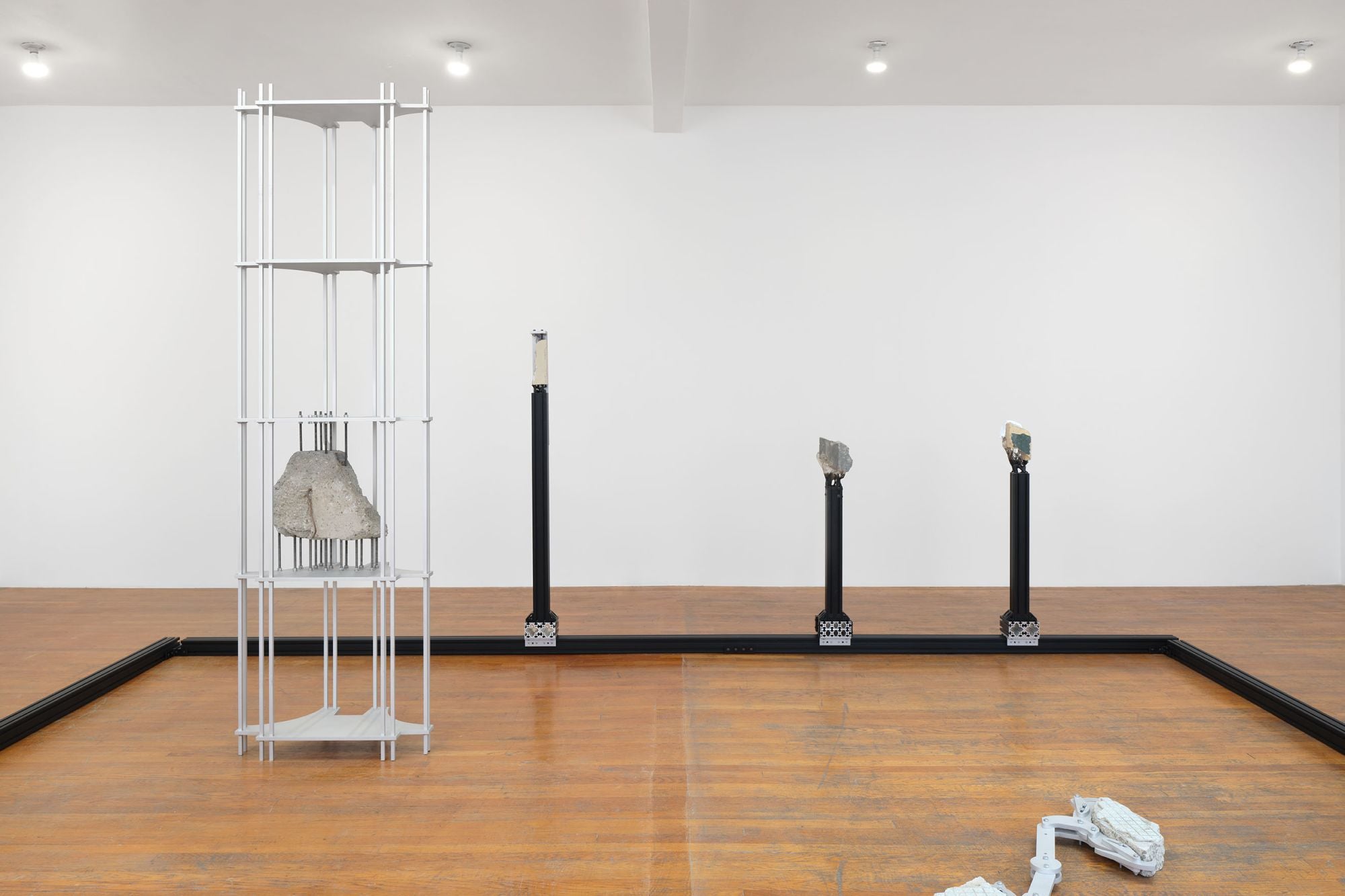
The Object Prosthetics series started in 2015 and concluded at Commonwealth and Council earlier this year. Can you speak a little about the iterative process of this project and what you were thinking about as its evolution coincided with the evolving technological trends of the time?
Cayetano Ferrer: Object Prosthetics involved a lot of research and experimentation that has been simmering for a long time. My use of the term “prosthetic” comes from my former professor Joseph Grigely's book Exhibition Prosthetics, which describes a similar approach in exhibition signage and text as a site of intervention. The project started as an investigation of fragments in LACMA's collection and led to thinking about fragments of the demolished museum itself as an artifact, or a remnant of the architectural and contextual frame. I 3D scanned these fragments in order to develop prosthetics that are contingent on absence and the shape of the fractured geometry. This is done using a computational design system that builds non-Euclidean geometries based on engineering conditions, and the results have a biomorphic quality. The project opened up an expansive idea of technologies and their histories. I visited a sculpture enlarging tool designed by James Watt at a museum in London, which has a relationship to the scanning and fabrication tools I use. A new tool I utilized for this project was a diamond wire saw used to cut pieces of the Ahmanson Building before it was demolished. This isn't the most high-tech tool but it’s specialized, and having access to equipment like this can open up important spaces of experimentation.
Object Prosthetics highlights the fictions that bind objects and structures within the institutional archive and reminds me a lot of Saidiya Hartman's ideas of critical fabulation—the way in which speculation fills in the gaps of history. How does fiction or “critical fabulation” inform your approach to visual restoration?
CF: There's certainly an affinity there. Archives are always incomplete, yet they are also a kind of technology of memory, and all the infrastructure built around them is meant to confer meaning and value onto the items that have passed through the threshold into the archive. That meaning and value in turn confers an idea of truth onto society, whether historical truth or evidentiary truth. These are very powerful systems, but I would argue often less coherent than we give them credit for. Where Hartman is introducing fiction to fill a lack of narratives in the archive, I'm interested in how museums are already full of fictions being propped up by the infrastructure of preservation. Many historical objects have been modified, altered, whitewashed. If I'm working through an idea of restoration in a work like Memory Screen from 2019, it's material research into how far I can push it. This is a speculative restoration where a series of fragments are brought together, and creates a feeling of reconciliation, but the final object does not reference a known type. It is outside of historical time.
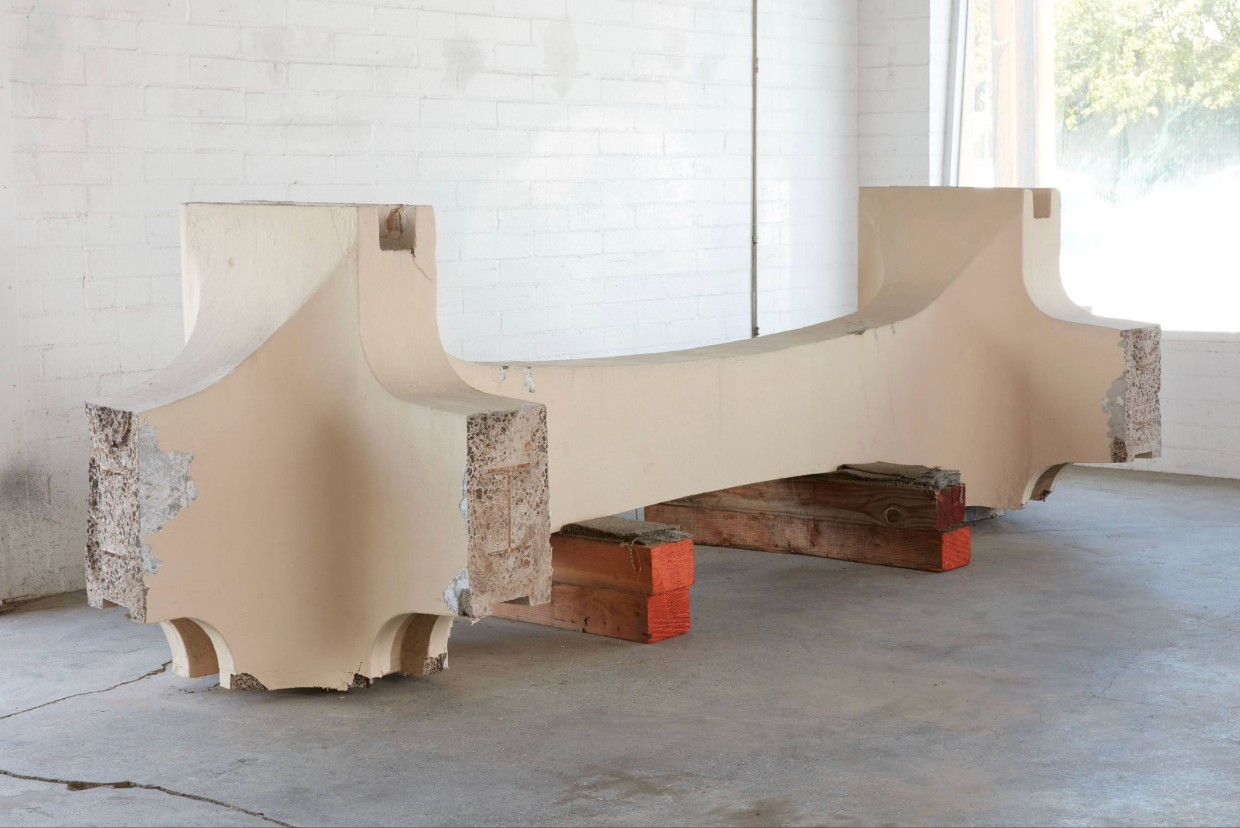
In Extraction, you worked with a lot of architectural pieces. How do you prevent these fragments from becoming mere relics? How can a prosthetic design keep the tension of the original rupture alive for the viewer?
CF: It's certainly not my intention to turn these fragments into relics, but I don't know that I would try to prevent that either. The more immediate reference is spolia, the ancient practice of incorporating old architectural stone into new structures. These works are material embodiments of shared memory, and these particular works are left very open. There will be some simple but meaningful interface with the ground once the precise location is determined. There will be light restoration work done according to the Venice Charter approach, which means any infills will be made with contrasting materials. But the intention in the final installation is to create the conditions where they might be used and interpreted in different ways. One person might consider this a conceptual sculptural gesture that I choreographed, another might see it as a specimen of William Pereira's design, another might recognize it as a weird bench and not think twice about sitting down. I've noticed some dissatisfaction with this answer, and I think it comes out of a desire for closure about the demolition that people think an artist can provide. I have always leaned towards art, music, and cinema that refuse resolution. It might also come out of a discomfort that an artist can do work almost indistinguishable from an act of preservation, which I outright dismiss. The point of Extraction is to denaturalize the act of preservation as a neutral gesture. The process of cutting, extraction, moving, and placement have enough charged meaning in our world. What's important is that I'm imposing a process onto the encyclopedic museum that is a mirror image of an extractive process that, collectively, encyclopedic museums have been performing for centuries.
How do you remember?
CF: I make art to remember, which I think is why the subtext of memory is always present.