




As LACMA prepares for the 2026 public opening of the new David Geffen Galleries, the future home of the museum’s permanent collection spanning a breadth of eras and cultures, we’re sharing 50 iconic artworks that will be on view in the building over the next 50 weeks in the series 50 Works 50 Weeks.
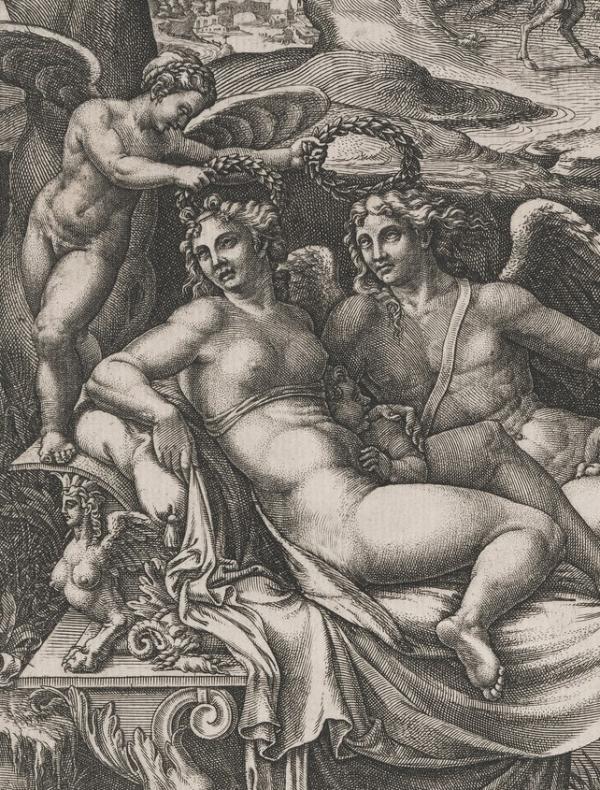
Love is in the air for gods and mortals alike in this engraving by the 16-century artist Giorgio Ghisi (1520–82), depicting the lavish wedding banquet of Cupid and Psyche. The couple’s love story comes to us from the ancient Roman writer Apuleius (about 124–170 CE), in his Metamorphoses, and tells of the son of Venus Cupid’s love for the earthly beauty Psyche, who must overcome various tribulations before her eventual union with the god.
Here, the couple are shown with their child Voluptas between them, crowned with laurels by a hora at left and joined by the goddesses Juno and Ceres at right, the latter of whom pours water on Cupid’s hand, signifying fertility and abundance. In the middle ground beyond the lovers, a group of satyrs prepare a goat for sacrifice. The pair lounge atop an ornate bed with a sumptuous cushion and sheet, while a dog rests beneath them, reinforcing the themes of love and passion that characterize their story.
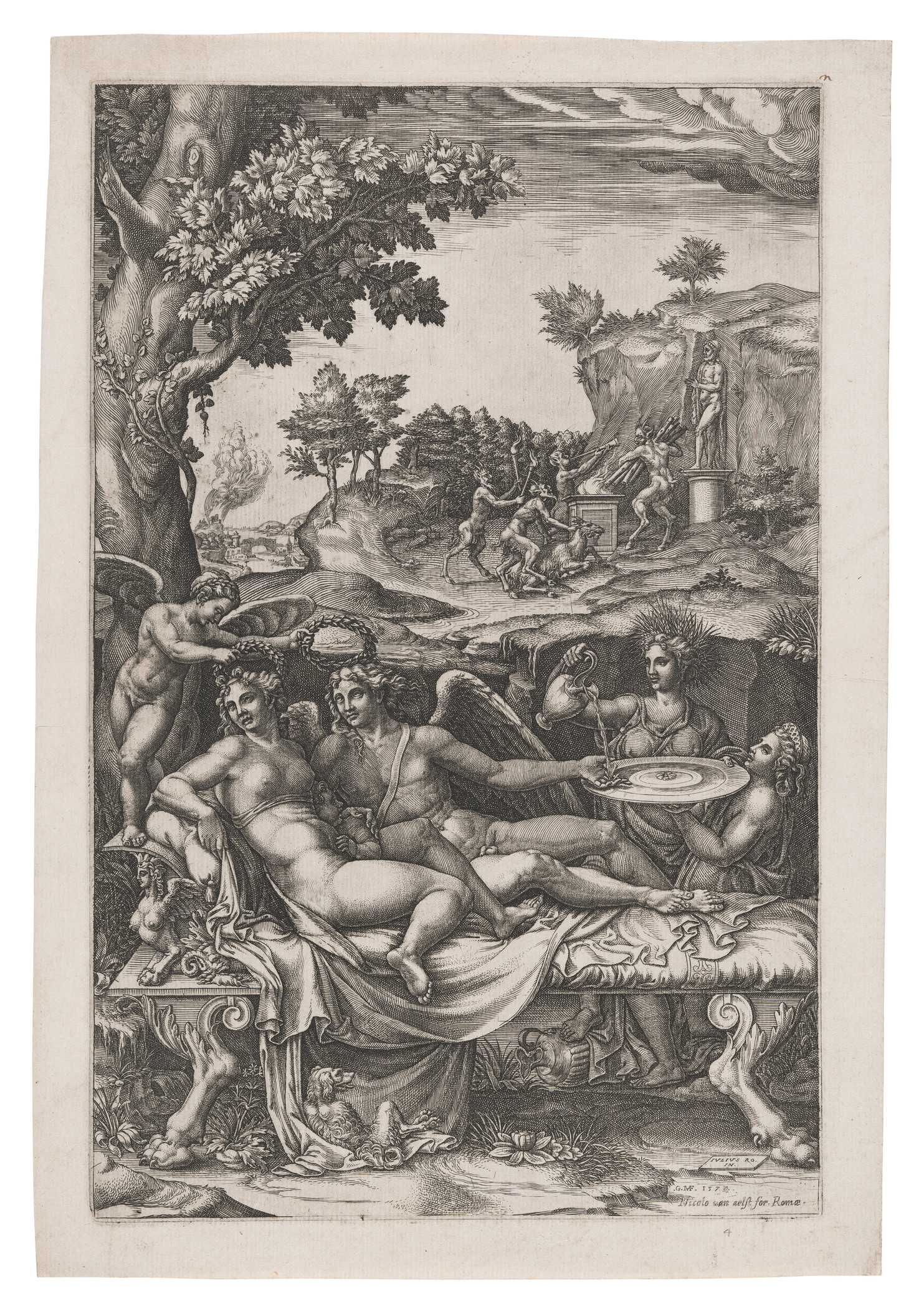
Ghisi’s engraving faithfully reproduces a fresco painting decorating the Room of Psyche, a luxurious dining quarters in the Palazzo Te, a leisure palace designed by Giulio Romano (c. 1499–1546) for the Duke of Mantua, Federico II Gonzaga (1500–40), starting in the 1520s. The room’s four walls and ceiling are painted with vignettes showing moments from Cupid and Psyche’s adventures and nuptials. Sometimes described as a “pleasure palace,” the Palazzo Te was rumored to have been built for the Duke’s lover Isabella Boschetta, called “La bella Boschetta” for her alluring appearance. However, the palazzo’s mythological frescoes and complex architecture suggest that it may have been used for diplomatic gatherings with erudite guests who would enjoy solving the Mannerist puzzles presented by the palace’s decorations—a sort of party game for learned audiences.
Subtle differences between the print and the fresco, such as the addition of foliage at the base of the bed or the billowing smoke beyond, suggest that Ghisi based this print not on the fresco itself, but rather on an early stage preparatory drawing by Giulio Romano, now presumed lost. Throughout his career, Ghisi traveled in Europe, creating engravings after various artists, including many site-specific works like the Palazzo Te frescoes. However, he was perhaps best known for his works after Giulio Romano, who was active in Mantua as the court painter to the Gonzagas during Ghisi’s early career, and may have shared his drawings with the engraver. Here, the sensual subject matter is enhanced by Ghisi’s skill in handling the engraving burin, producing velvety shadows in contrast to the bright light of the bare sheet, showing at once the various textures of the body, luxurious fabrics, and richly dense foliage.
This print is an outstanding example of Ghisi’s work as a printmaker, and came to LACMA thanks to the Mary Stansbury Ruiz Bequest of 1988, which included more than 600 Northern and Italian Mannerist prints collected by Mary Stansbury Ruiz in Los Angeles beginning in the early 1970s.