




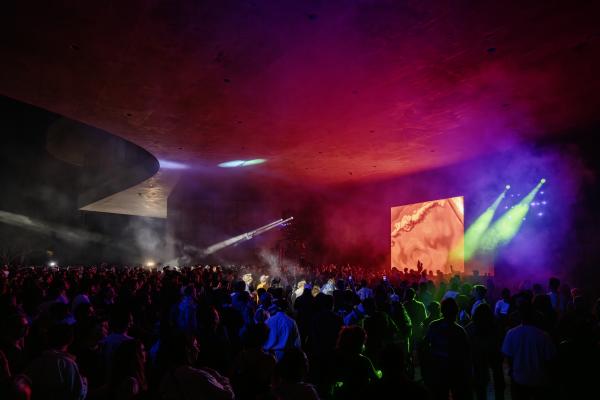
Growing up in Los Angeles, summer has always made me think in one way or another about oil. The hazy orange skies over the Inglewood Oil Field, the hours-long traffic to the beach, and the memories of peeling tar stuck to the bottom of my feet are all reminders of the way oil undergirds Los Angeles, a city that at one point was one of America's largest petroleum producers. My preoccupation with oil reached its peak during the recent summer solstice when artist john gerrard, in collaboration with Richie Hawtin, transformed LACMA’s campus into a dance venue to present the latest phase of his year-long artwork SPIRITS.
Developed with LACMA's Art + Technology Lab, SPIRITS hones in on the lingering impacts of 20th-century industrialization and the way it continues to haunt the contemporary moment. gerrard created 96 digital portraits of plastic sandals and shoes collected from beaches across the world, which are presented on LACMA’s homepage across four 24-hour events tied to the solstices and equinoxes. Participants are able to virtually interact with their digital forms, the remnants of a society dominated by oil, extraction, and commerce. For the recently released Summer Solstice (Mediterranean Sea) phase of SPIRITS, gerrard expanded the scale and form of the series by moving beyond web browsers to a multimedia installation and performance at the SPIRITS Summer Solstice Dance at LACMA on June 21, where he immersed thousands of people in his artistic investigation of the relentlessness of consumerism and capitalist empire.
I recently spoke with gerrard to learn more about the themes embedded within SPIRITS, the evolution of the series, and its life online as well as at LACMA.
SPIRITS is an art piece that is actualized by the viewer’s engagement with it. For the SPIRITS Summer Solstice Dance, how did you shift from the intimacy of mobile devices to large-scale installation and dance?
john gerrard: SPIRITS lives first on the browser and then on the phone. That is where many people meet it, alone, holding the work in one hand, moving oil slicks, ocean currents, cultural memories, disasters, and algo-acoustics across the surface of a lost plastic shoe with a single finger. The SPIRITS Summer Solstice Dance took this single gesture and made it collective. The gaussian image-objects that you usually hold at arm’s length were now rendered live on a large LED wall by two performers, 92Jelani and Anastasia Giovani, who inherited the SPIRITS world and animated it as the sun set in L.A. Four thousand people picked up the gesture, both visual and sonic, with their bodies. What did not change was the core act: the work is completed by the people moving through it and with it, whether that is on a screen or on LACMA’s campus.
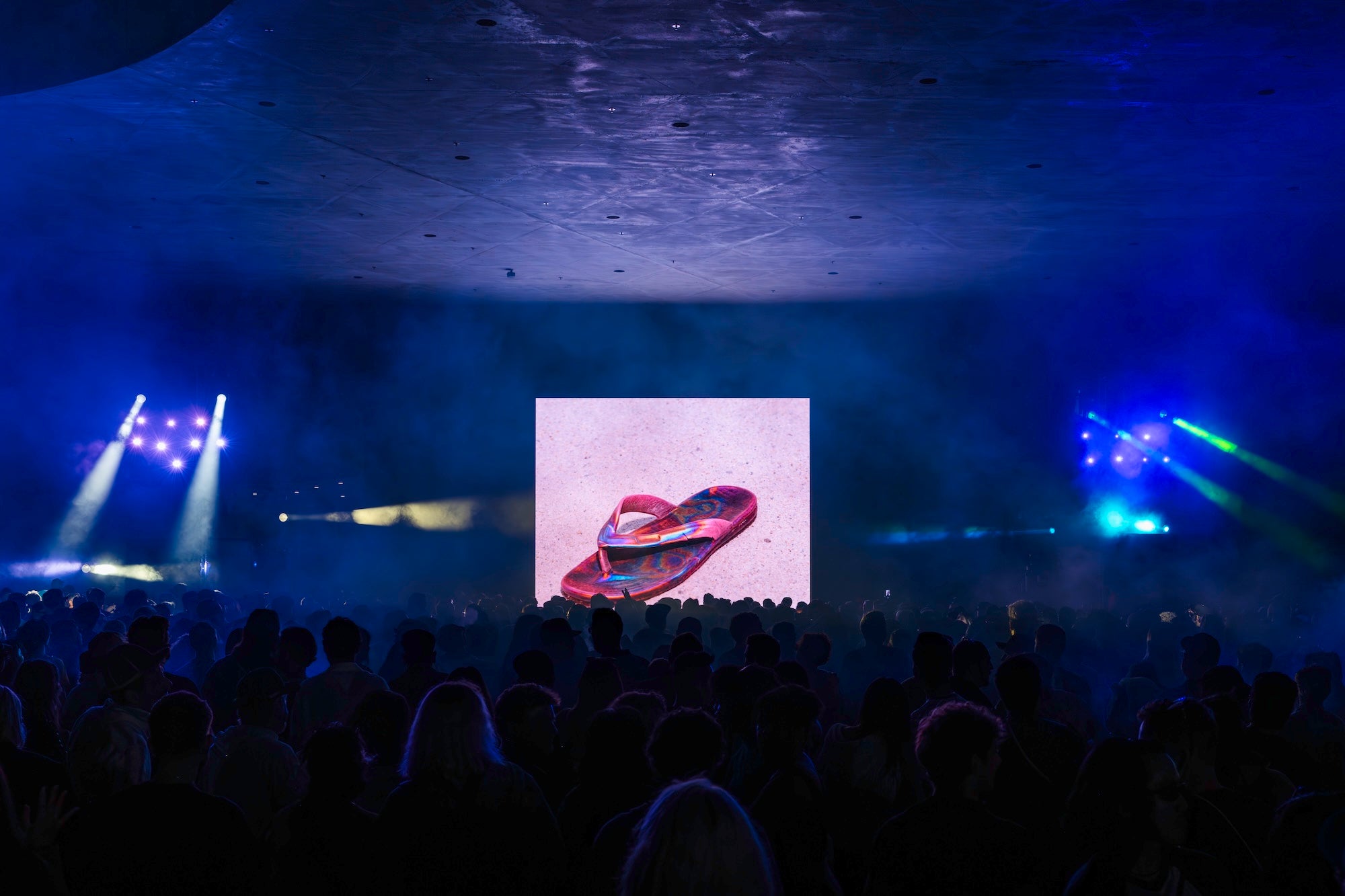
In your work, there's a fascination with glossiness—the way it covers, adorns, and oozes out of consumer goods. Can you tell us more about the way gloss functions within SPIRITS?
jg: Gloss is the surface of consumption. It is how objects appeal to us: the shine of something unused, the slick look of the new, the lacquer that says “I am perfect, I am unworn, shame-free,” where use and shame are so tightly linked socially and commercially and in media. In SPIRITS the shoes are the opposite of new. They are discarded, worn, lost, and in some manner pathetic, found on beaches across four oceans following months, years, and I think sometimes decades at sea. Our simulation gives them back this impossibly rich contemporary shine, this oil iridescence. The gloss is beautiful and it is also the thing that is boiling the earth. The rainbow on the surface of the work is the same rainbow you see in a puddle of petrol on a garage floor. I wanted a doubleness held on one surface—the thing that draws you in is the thing also doing such profound damage, a push-pull where we are dazzled by the gloss whilst we cannot see underneath it to the ruin of the earth, the hell of a burning planet. The works are psychedelic (or perhaps psychotic) in this light: that we may exist within a vast petroleum hallucination, and this strange new space of techne, AI, WebGL, tone.js allows a novel artistic vision within it.
A deeper inspiration for the entire SPIRITS series began with Ed Ruscha’s gunpowder drawings, which take an explosive material and wring from it a potent portrait of mid-century American life with subjects like “OILY,” “MOTOR,” “LA,” “CORN,” “POOL,” and “WAX.” Gunpowder on paper was an effective way for the artist to speak of a very particular form of violence in American life in the 1960s and to do so quietly, where the meaning is embedded in the material and also in the resulting work. Thus, if SPIRITS has an ancestor, it could be those brilliant Ruscha drawings that resonate all the stronger across time.
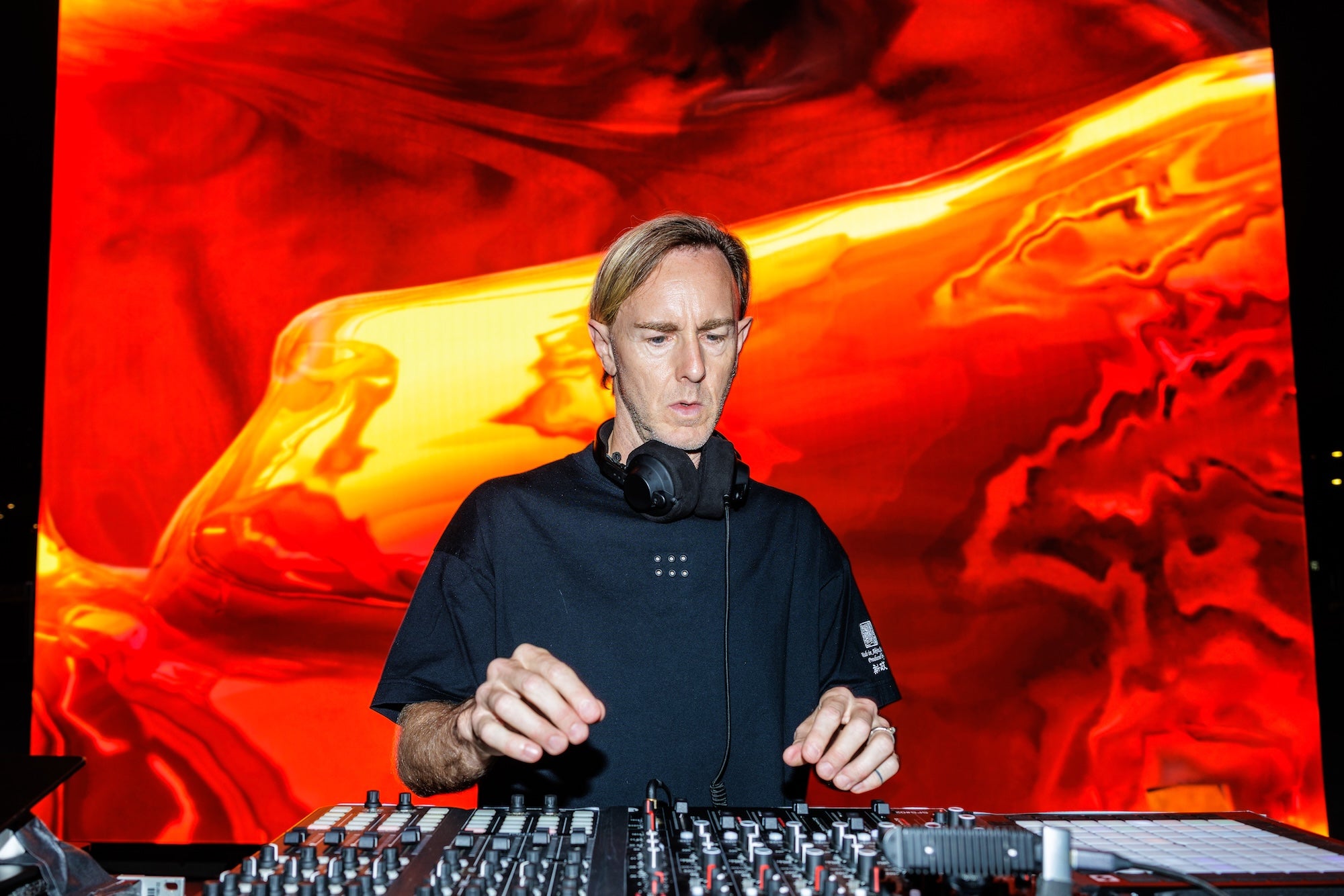
The soundscape of the SPIRITS Summer Solstice Dance was in conversation with the sonic lineage of Detroit techno. How did the collaboration with Richie Hawtin (Plastikman) amplify the sonic elements of the work?
jg: Richie Hawtin began in Detroit, a specific place where machines, industry, and productive repetition were in freefall. Acid house and eventually techno became an alternative future imagined from inside the ruined husk of a factory. That is precisely the territory SPIRITS seeks to occupy. Richie listened to both the Winter Solstice (Pacific Ocean) and Spring Equinox (Indian Ocean) releases with us and his comments for the Summer Solstice release were to iterate across the worlds of the work—to develop the language using the solar logic of the emergence of each ocean. In that sense summer is the most album-like and the section where Richie is most present, though the legacy of Richie is most present in spring, where acid house traditions roll into techno. We sampled acid house flyers from the late ’80s into the ’90s in the UK, where black ink is printed directly onto electric green, yellow, and pink. For the Summer Solstice we built “Peak Oil,” a psychoacoustic composition using dichotic listening, with the words “peak oil” moving from one ear to the other at high repetition until the phrase dissolves into something else and returns.
The spirits themselves were performed live by two brilliant musicians who Richie invited, Anastasia Giovani and 92jelani. Using touch screens and a custom interface the works were visually presented and acoustically evolved in front of a crowd of 4,000. It was extraordinary for myself as the artist and for producer Werner Poetzelberger to hear where the sound went—sometimes it goes in completely unexpected places. Richie brought his four decades of understanding how a room full of bodies moves through rhythm and repetition: when to build, when to hold, when to release. That is authorship of its own kind, and it was central to what the night became. There are few artists like him and at a certain point, magic happened. It was a great joy to see digital art, culture, and music presented at LACMA at such scale combined to produce a profoundly moving moment.
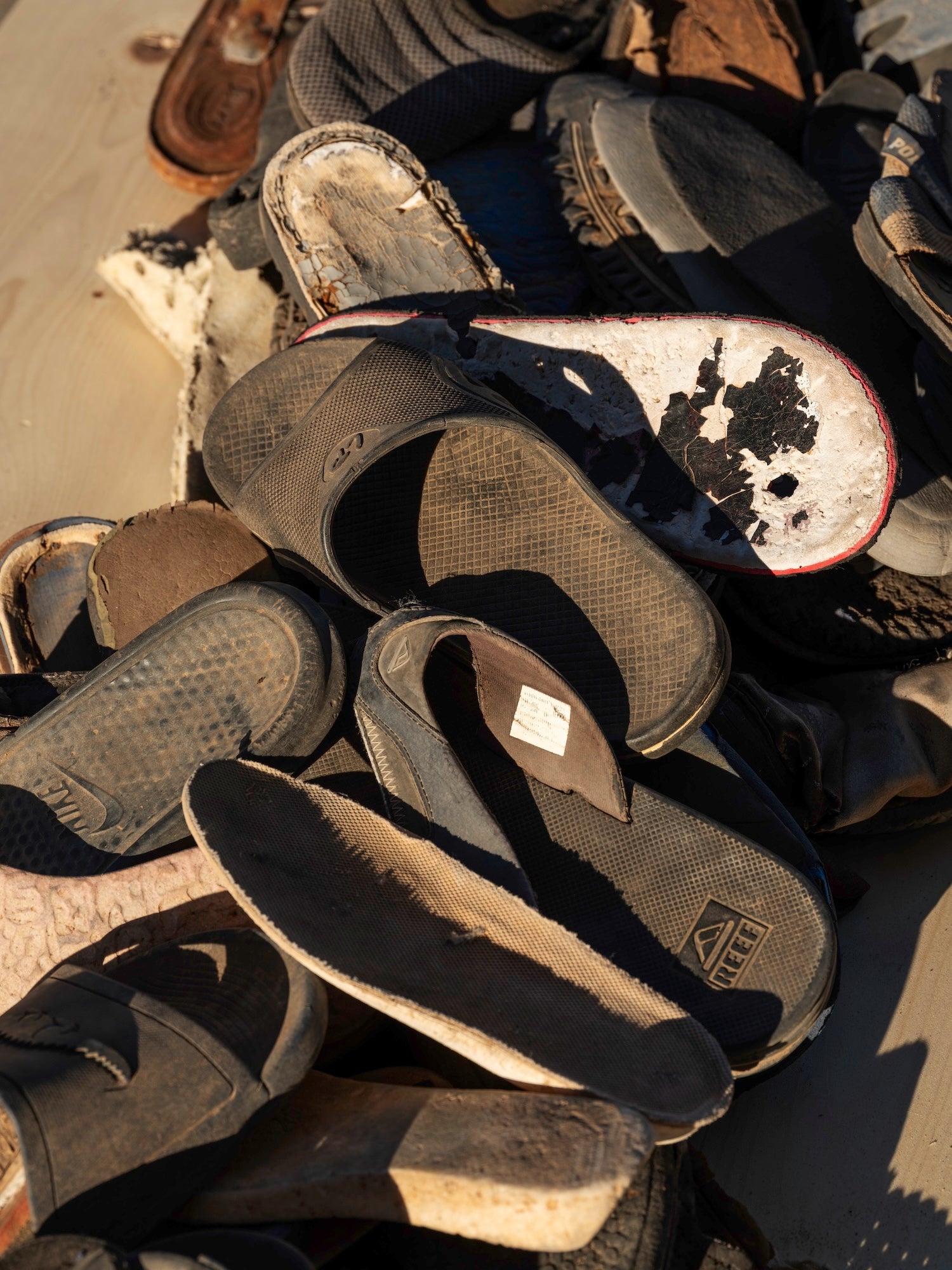
SPIRITS uses the afterlives of people’s shoes to tie material cultures to the impact of industrialization in the 20th century. The serial nature of the shoes themselves raises the question: what’s left after catastrophe? Who bears witness to that? I’m wondering how you were thinking about power and authorship as you were crafting this archive.
jg: The shoes are the most ordinary objects imaginable. Everyone owns them. They are made in their billions and they then outlive us—plastic does not break down in any span of time that means much to a human life. What is left afterwards is a most banal thing: a sandal, not a monument. But accumulated, they become a global disaster that intersects with culture in many complex ways. Most of all I wanted to link the vast variety of shapes and colors of shoes to one material: oil. All the shoes are plastic and oil is at the core of that material. I am not sure that many consumers actually know that. Certainly it is disguised in your average sports store. That said, I am wary of the artist as sole author. These shoes were made by workers I will never meet, worn by people I will never know, and carried by currents I do not control, and the work is only ever completed by the viewer. And that is outside of the many production roles in making the game engine–based worlds of the works themselves. My role is to hold all of it still long enough to be seen. The witness is not me. It is whoever picks up their phone, or whoever was dancing that night, and understands for a moment what the gloss is made of and even, what it could mean.
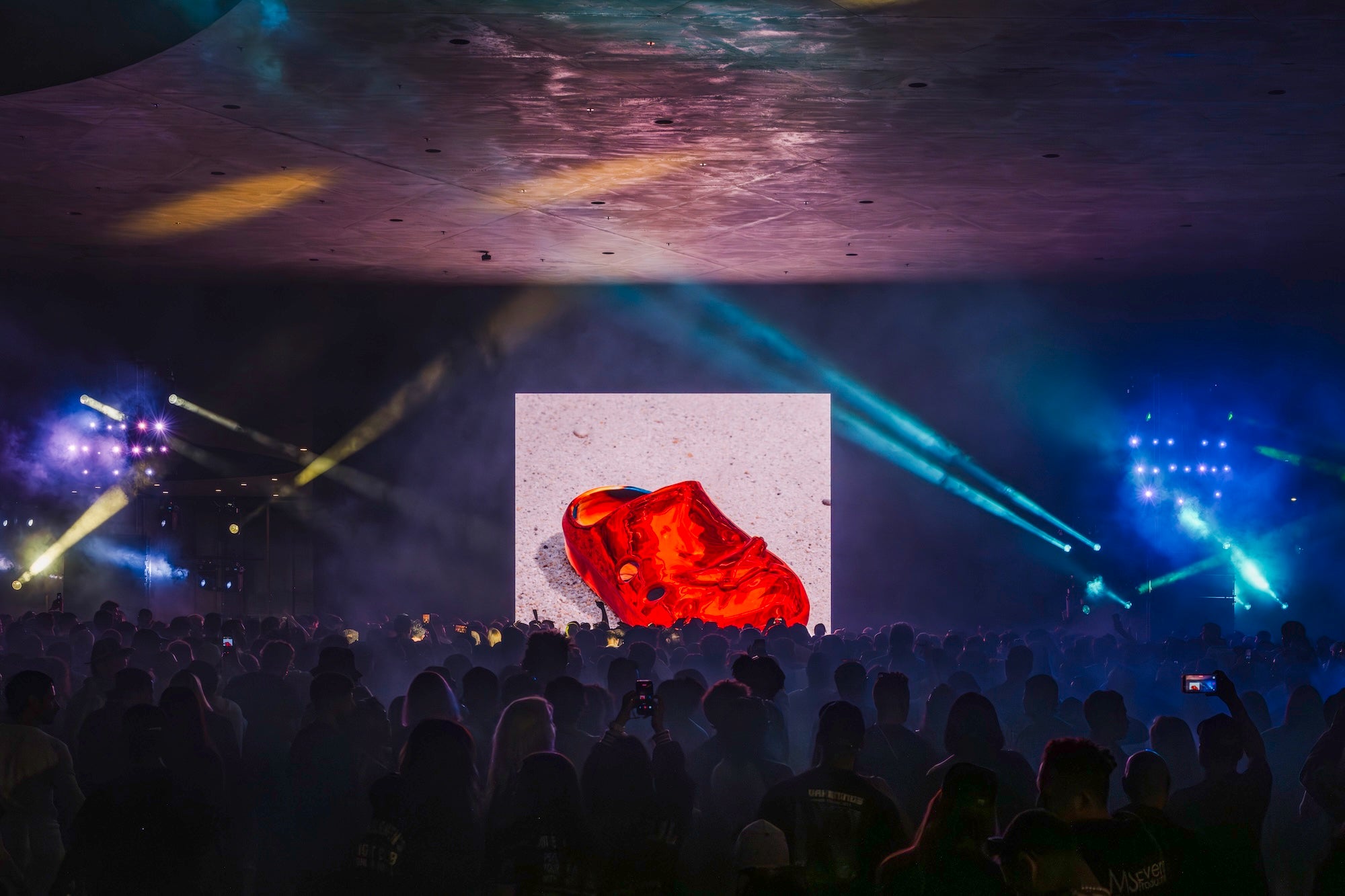
A final note, the event took place adjacent to the La Brea Tar Pits, so the dancers moved above ancient sunlight trapped in the oil beneath their feet. In an expanding metaphor of layers, from underworld to commons, museum, and (digital) network, there lies a clue as to a new form of global witness. In my own work I am dancing around a little, opening my own art beyond geography and place. If one was to map my path as an author and witness going forward, it would be these elements, all present at LACMA, that are my spirit guides.