




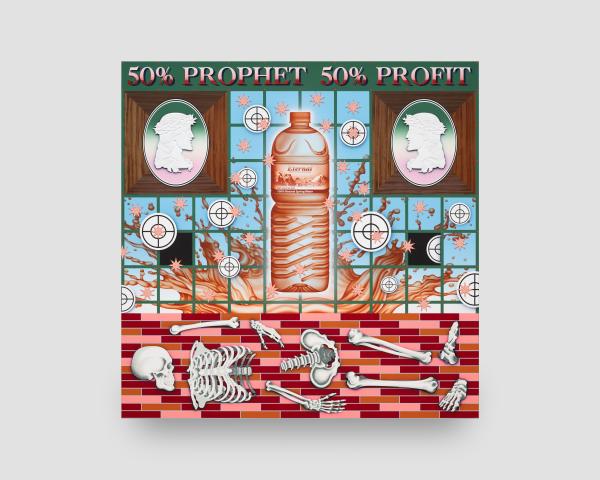
We are pleased to announce the Art Here and Now (AHAN): Studio Forum artists of 2025: Sula Bermudez-Silverman, Claire Chambless, Karla Ekaterine Canseco, Ali Eyal, James Iveson, Young Joon Kwak, Jaime Muñoz, and Roksana Pirouzmand
AHAN: Studio Forum was founded in the 1960s as a group of LACMA supporters dedicated to supporting emerging and mid-career Los Angeles–based artists while strengthening the museum’s contemporary collection. Each year the curators of the Contemporary Art department organize a series of studio visits with the AHAN members. They reconvene at a later date for a discussion that leads to a final selection of artworks. Below, read about the selected 2025 AHAN artists and the works acquired.
Sula Bermudez-Silverman
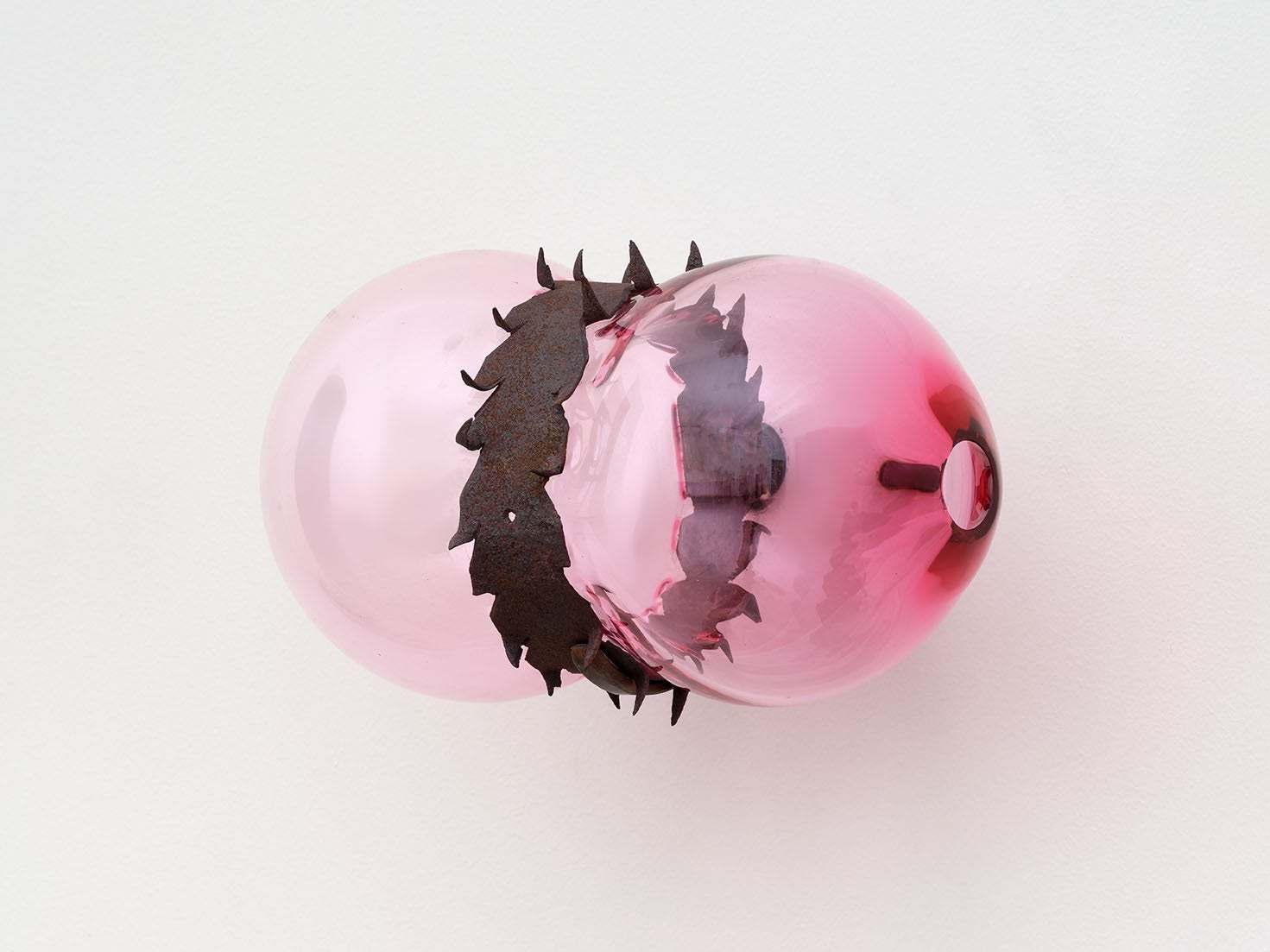
Sula Bermudez-Silverman draws our attention to material culture—the world of objects and architecture that surrounds us—illuminating histories that are often obscured or elided even as they are present in our everyday lives. Her recent works use bulbous colored glass forms distorted and contained by aged metal tools such as animal shears and bridles, one material conferring a soft, organic, bodily quality and the other suggesting the violence of control. This series of works is entitled “blister,” a word that both describes the bubbling quality of the glass, and alludes to damaged skin and surfaces.
Blister vii, which LACMA acquired, is an oblong pink glass orb constricted in the center by a rusted iron dog collar, the sides of which have been scored and bent to create rows of sharp spikes. The resulting object, with its delicate symmetrical, transparent bulbs and the palpable harshness of the collar, testifies to Bermudez-Silverman’s adept use of materials. The form that emerges where these two elements come together reveals questions of domination, submission, the body, and sensuality.
Claire Chambless
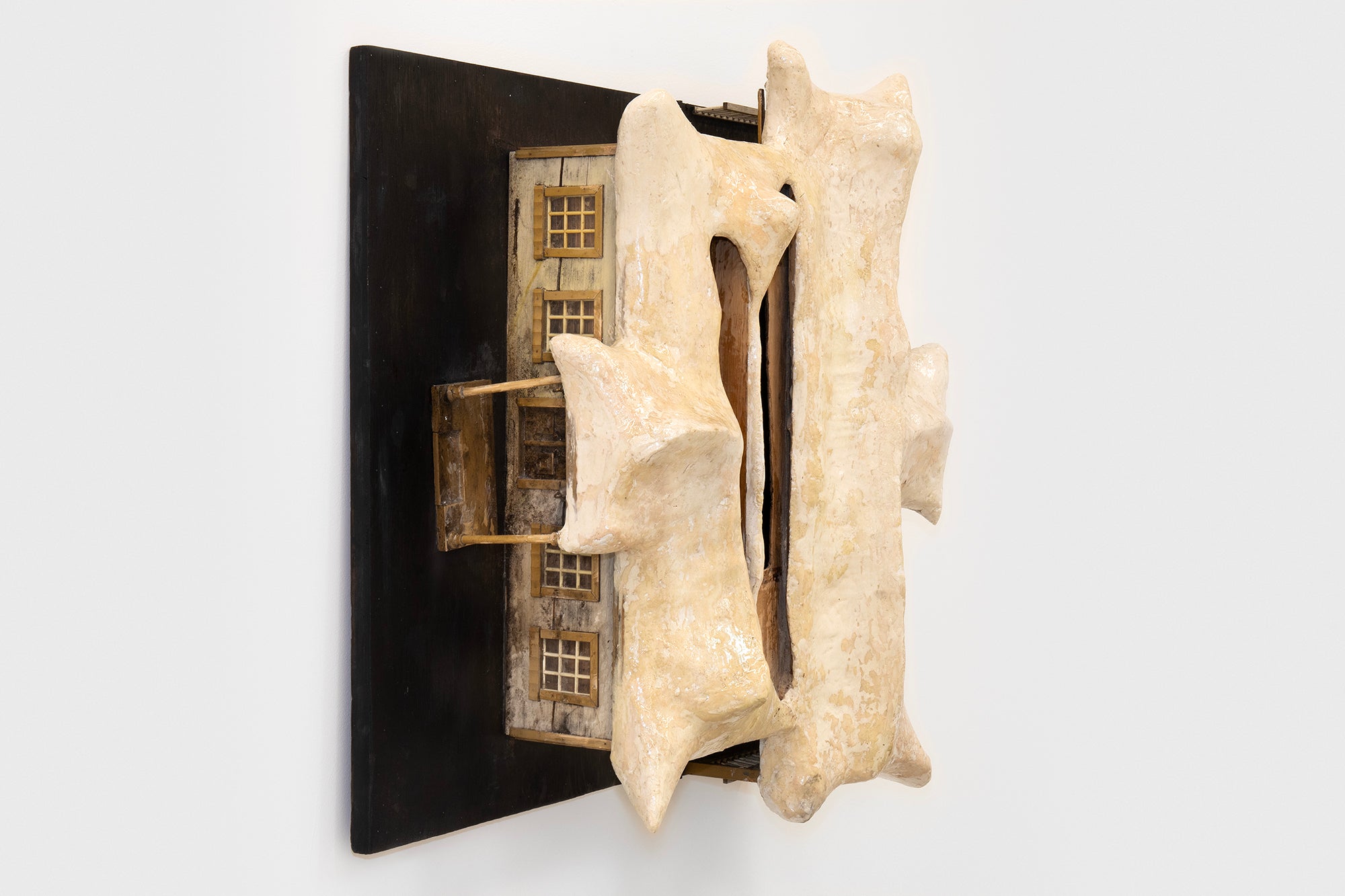
Los Angeles–based artist Claire Chambless works predominantly in sculpture, frequently overlaying a synthetic foam-like material over found objects. Chambless’s influences are drawn from architecture, psychoanalysis, and fairy tales. Her shifts of scale and perspective align with Surrealism and its related preoccupations with undoing the familiar.
Ghost Complex No. 6 (aerial view) gives a sense of the topsy turvy nature of Chambless’s practice. Chambless’s sculptures are frequently mounted on or slightly off the wall to reveal different vantage points. The piece uses a salvaged dollhouse and features the artist’s signature overlay of delicate domesticity with seemingly toxic conditions. What appears to be an abstract form reveals a hidden set of uninhabited miniature rooms.
Karla Ekaterine Canseco
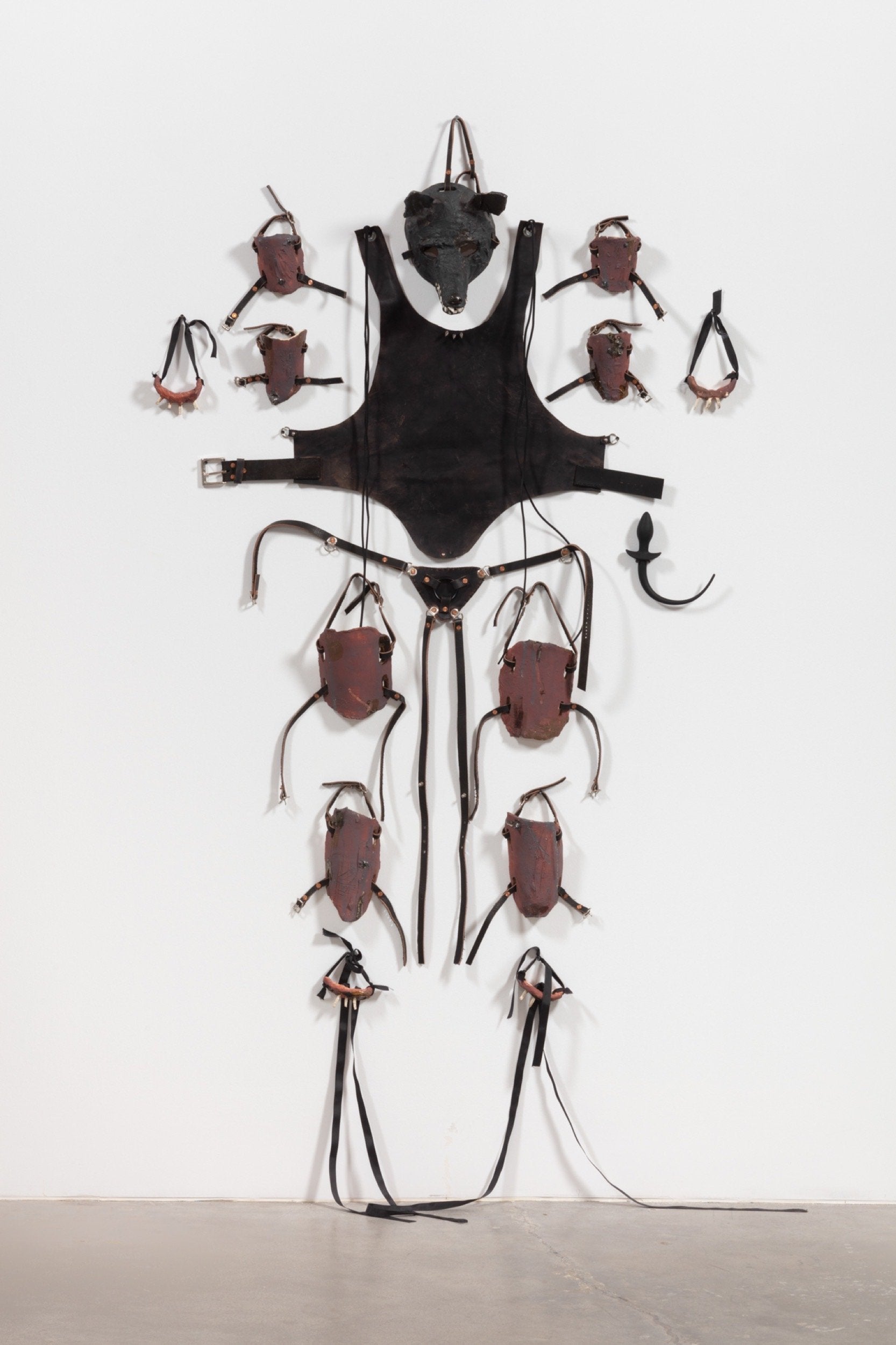
Karla Ekaterine Canseco is an interdisciplinary artist based in Los Angeles and Mexico City. She works primarily with clay and metal, and has also staged performances. Canseco explores subjects such as intimacy, violence, mythologies, and colonial histories and is drawn to how matter, like our bodies, also carries information that has been passed down and is present. Our bodies collapse conceptions of time and hold stories in the same manner clay transcribes in its composition and impression. In making, she invites her history within, daydreams, and poetics to materialize into sculptures forming her personal and shared mythologies. Pedazos de perra features a lithe canine figure, resembling the xoloitzcuintli (a hairless dog common in Mexico) that is an alter ego of sorts for the artist. Hanging as a costume or puppet, the piece references sadomasochism regalia. There is a suggestion that the hanging sculpture can be removed from the wall and activated.
Ali Eyal
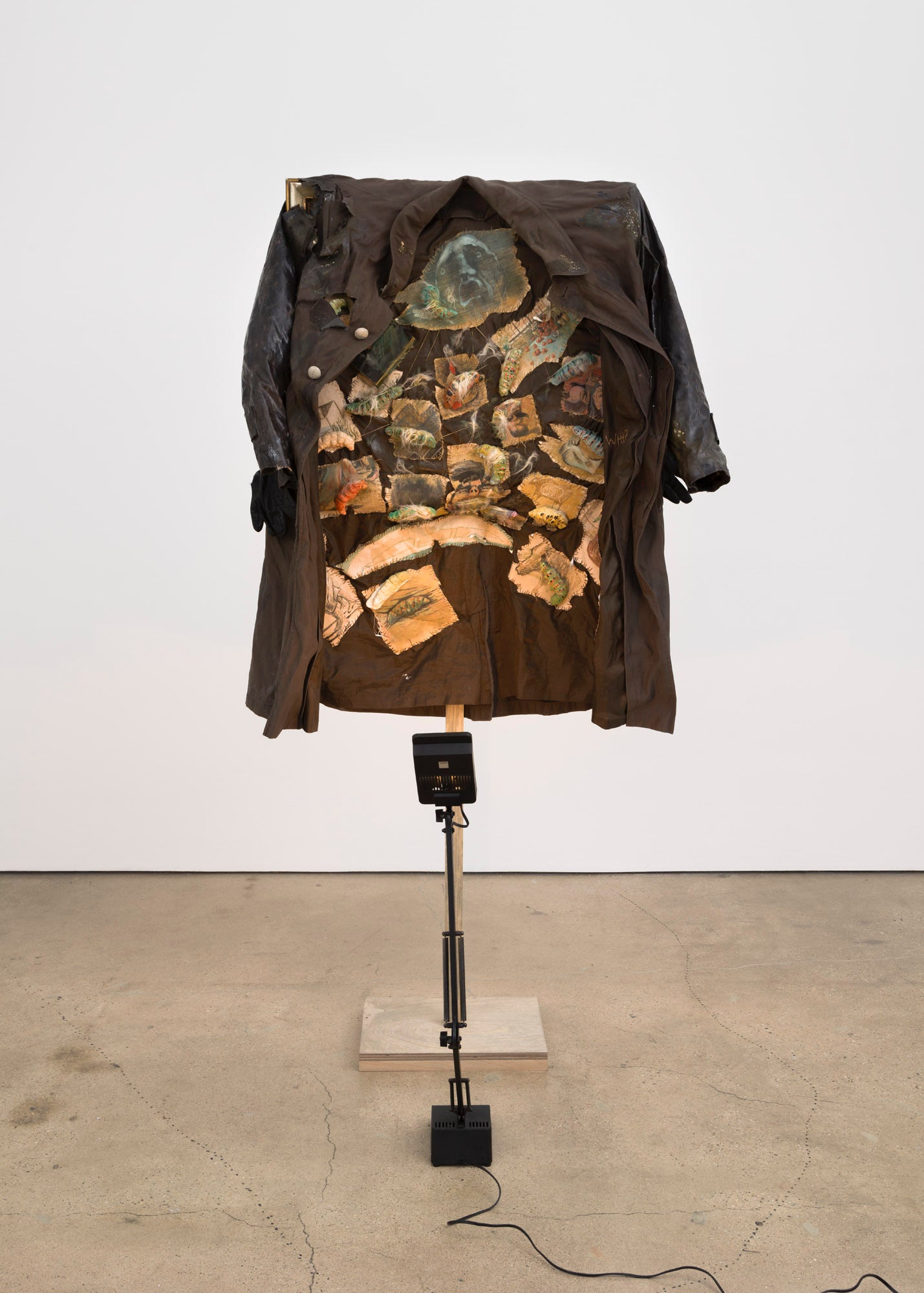
Many of Ali Eyal’s interconnected works emerge from his personal experience, marked by the U.S. invasion of Baghdad, his home city, and the violence, destruction, and subsequent unraveling of Iraqi civic life it engendered. Writing is a major part of Eyal’s practice, and in the case of this work he writes of a deconstructed and reconstructed museum on a farm, a recurrent setting for the artist. In Eyal’s tale, paintings that were lost in the war are found and exhibited, but “small butterflies were born which fed on the wood of the stolen canvases, taking on the details of the paintings as homes.” Where do the walls of the museum go when they are forgotten, And is a sculpture that emerges from this narrative for which the artist has stitched scraps of paintings and lumpy ceramic caterpillars onto the lining of a dark green jacket.
When the museums of Baghdad were looted after the American invasion, significant artifacts were lost to theft. Eyal’s sculpture refers to this loss, but, as with the rest of his work, he acknowledges this reality only through the fantastical and strange. Carrying things on the inside of a jacket is a means of smuggling that which is valuable. In this case it is fragments of culture that need to be preserved, and in a surreal touch, it is also caterpillars—creatures that if cared for will transform and reemerge in another form.
James Iveson
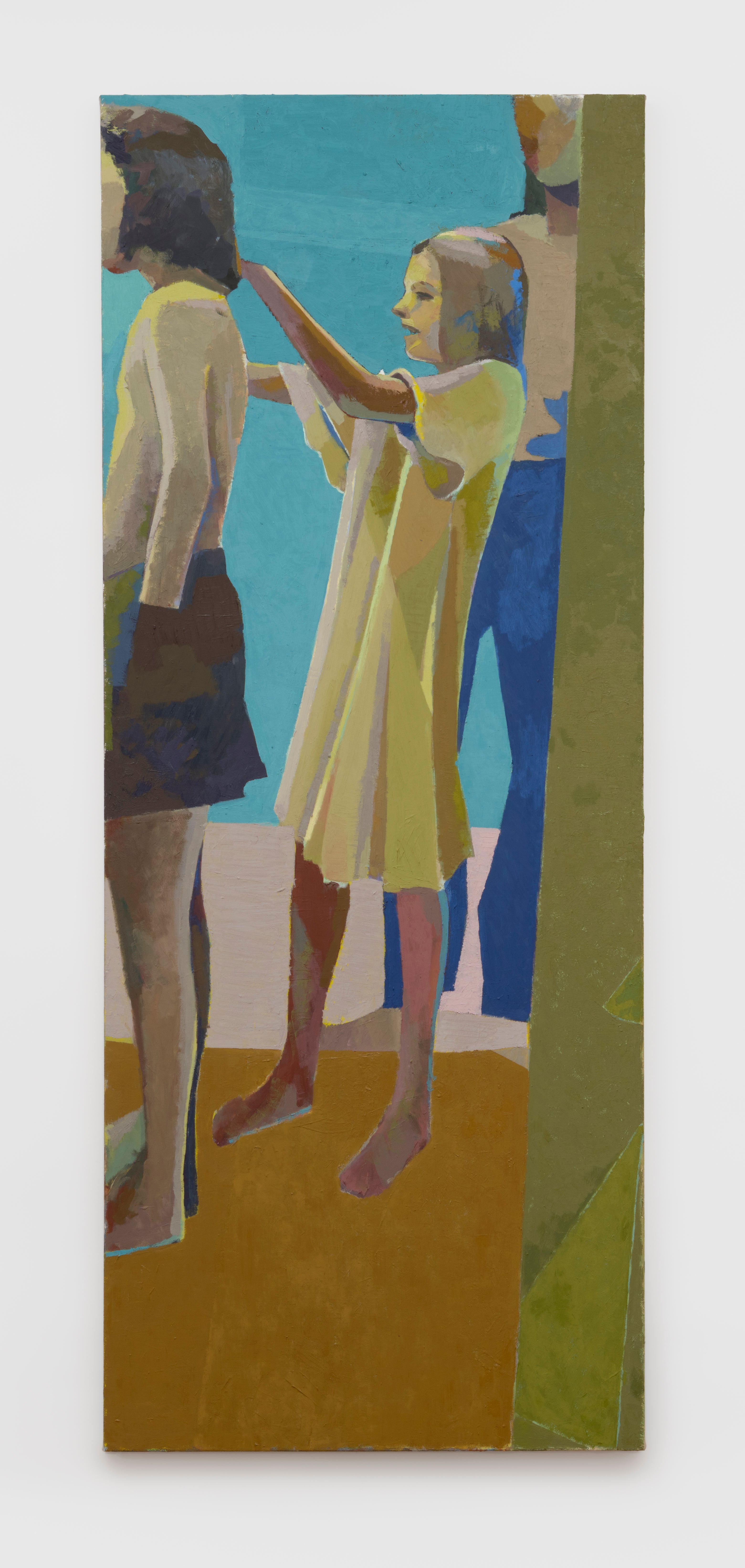
James Iveson's figurative paintings suggest a familiarity with their subjects but are as often likely to be photographs of strangers than family and friends. In this spirit of spontaneity—and with a loose, abstract proclivity—Iveson allows for bodies to float into loose and colorful shapes. The title of the elongated painting Pont du Gard alludes to the Roman aqueduct bridge outside Nîmes but this is not a painting of a historical site or touristic view. Center to Iveson’s pictorial moments are fleeting moments, the rush of passing figures or a glimpse of an action in progress. Elongated streaks of oil on linen create the boundaries of a lived-in space, perhaps a corridor. The gesture of one girl aiding another on a typical morning rhymes with Iveson's movements on the canvas and alludes to the architectonic space oftransit. In this and other paintings, he endeavors to locate the space “between the reality of the painting as substance, color, and geometry with the fragility and intimacy of the depicted moment.”
Young Joon Kwak
Young Joon Kwak is a Los Angeles–based artist who works primarily in sculpture and performance. Kwak’s practice is an exploration of how we see and depict bodies, particularly those of queer, trans, and non-binary people. Her works challenge traditional ways of representing the self and others, and instead reveal the ways in which we are both visible and unperceivable. These representations allow for opacity but are a resolute insistence on presence, a declaration in the face of violence and erasure.
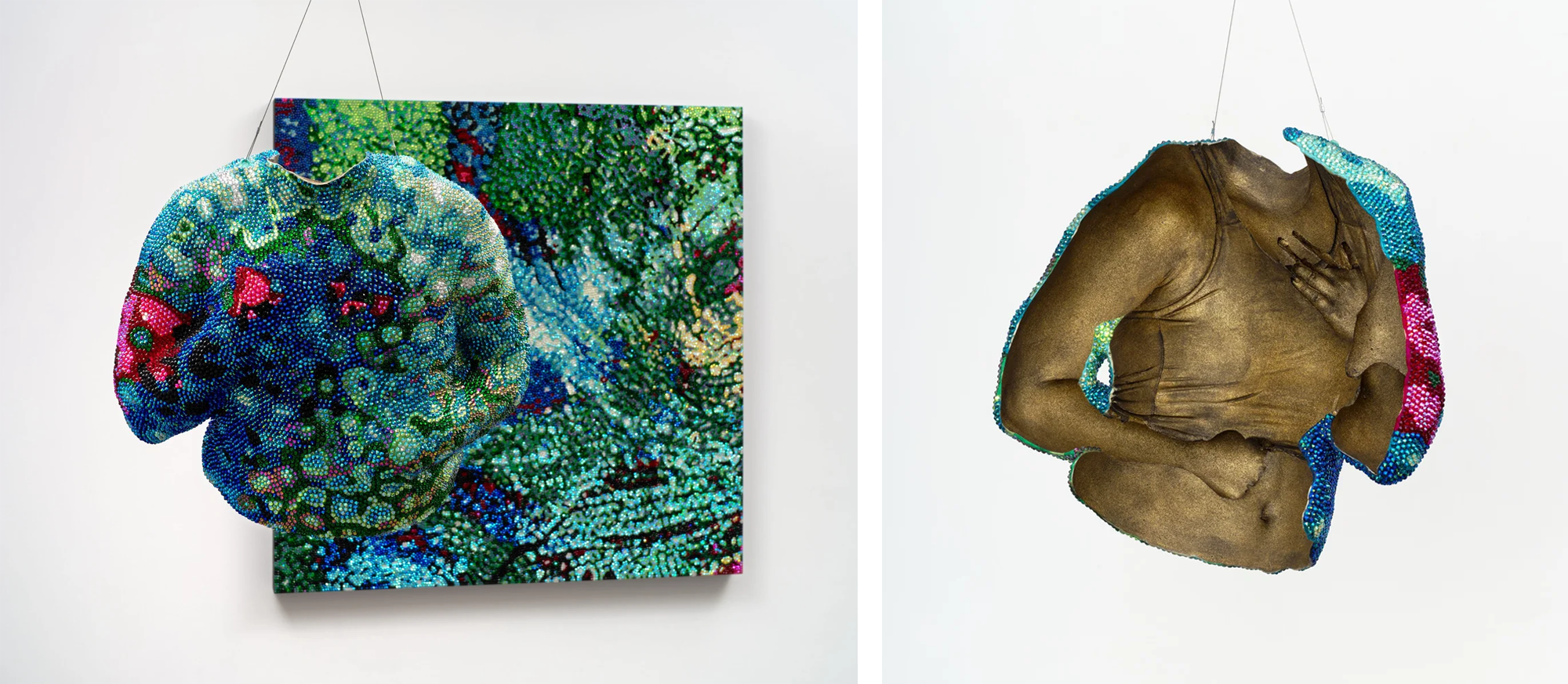
To See Your Self Reflected in Our Chameleonic Transformations (Neither Death Nor Dysphoria); To Refuse Looking Away From Our Transitioning Bodies (Charlie With Chest Binder) was created as part of presentation featured in Made in L.A. 2023: Acts of Living at the Hammer Museum. Kwak made three works that each have two parts both covered in a camouflaged, chameleon pattern of rhinestones: a two-dimensional painting-like component that hangs on the wall and a cast torso suspended in front. Here, Kwak’s friend Charlie is represented; the work shows their torso with their arms wrapped around it. This frontal, convex side is covered in brightly colored blue, green, teal, and pink rhinestones and contrasts with the the concave back of the piece, a darkly colored resin that bears the details of the body from which it was cast, including the chest binder mentioned in the title. When seen head on, the body blends in with the canvas behind it, but when approached from another angle, the back becomes visible and the optical qualities of the reflective, patterned material shift. The resulting work encapsulates many of the concerns and aesthetics of Kwak’s practice: the shifting and mutable self, the intimacy of the body, and the politics of visibility.
Jaime Muñoz
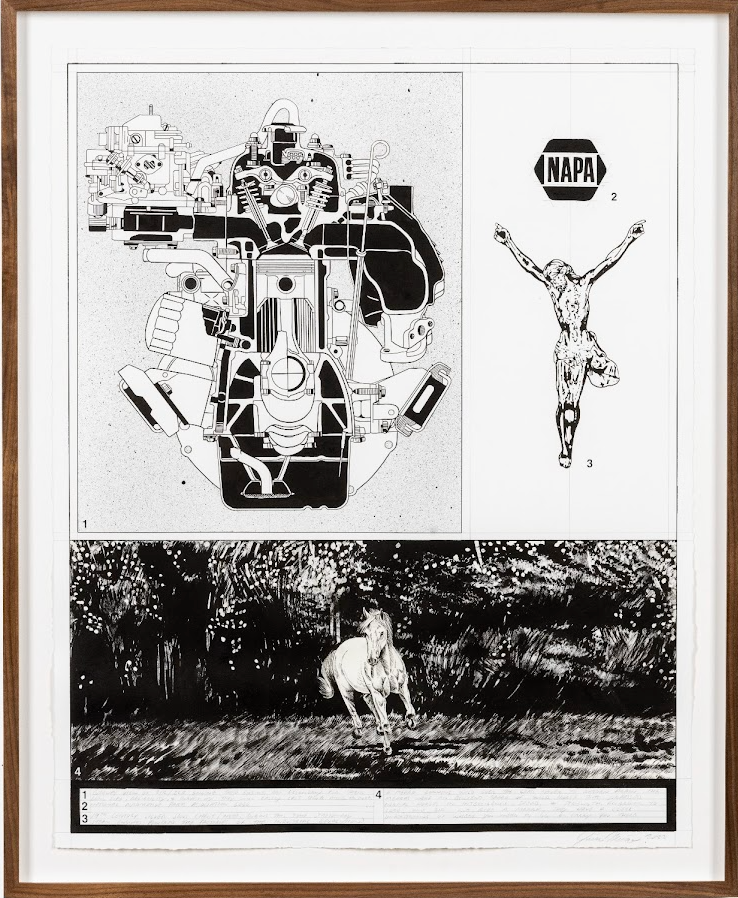
Jaime Muñoz studied graphic design before he began painting. In community college, he worked physically demanding jobs pouring concrete or working as a house painter. His professor Mitchell Syrop, an artist represented in LACMA’s collection, noticed Muñoz’s talent and encouraged him to pursue a fine arts degree at UCLA. In his breakout body of work after completing his Bachelor of Arts at the University of California, Los Angeles, in 2016, Muñoz used a Toyota truck as a central motif to probe the representation of working class Mexicans and Chicanos. Labor and the visual language of the working class are themes that run throughout his practice. His compositions draw aesthetic influences from Latin American modernism, Mexican muralism, and subjects from Baroque-period painting, particularly Catholic themes and iconography that reference colonial history. He culls images from advertising and uses materials like spray paint and glitter to examine how certain techniques and materials are imbued with economic and social status.
Roksana Pirouzmand
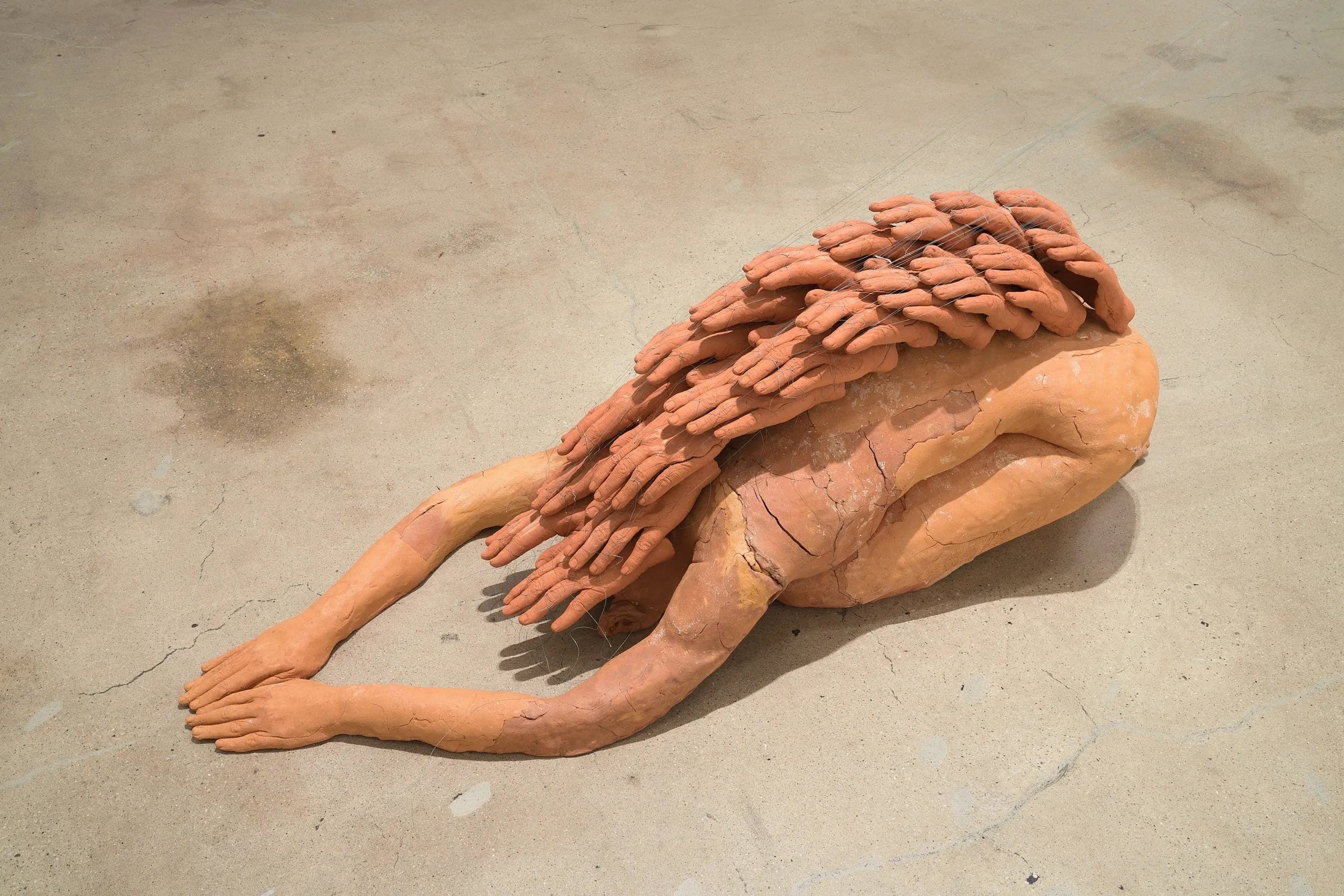
The female body reappears throughout Roksana Pirouzmand’s works, whether in etched drawings on the surface of clay tiles or as disembodied forms cast and replicated in ceramic. A tap, A word employs the prostrate female form and the gesture of rhythmic tapping. The artist has described this posture as one of supplication, a metaphor for the way she sees the desperation of the people of Iran. Ten sets of side-by-side hands run along the figure’s spine; they are cast from the artist’s mother’s hands. The fingers of each are tied with strings that run to a spool attached to a simple motor hung high on an adjacent wall. As the shaft moves up and down the strings are pulled tight and released, and the hands rise and fall against each other and the figure in unison. One body is communicating to another, an idea captured in a poem the artist wrote after the title of this artwork:
A tap, a word
To remember
To caress until it all falls apart
Past rubs itself against present