




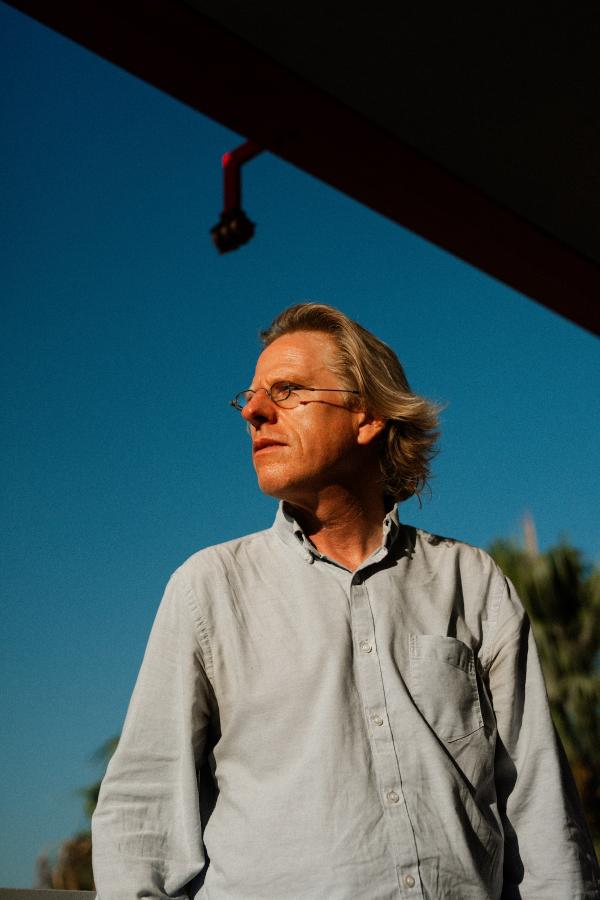
Deep Time Cinematography is a site-specific conceptual artwork by Jonathon Keats that will create a 10-frame zoetrope movie of the Hollywood Hills over the next 10,000 years. Keats, a 2015 recipient of the LACMA Art + Technology Lab grant, utilizes a handcrafted pinhole camera, installed on the escalator landing of BCAM, Level 3, to capture 10 millennium-spanning portraits of Los Angeles’s evolving landscape.
Through its radical temporality, Deep Time Cinematography is Keats’s powerful call to the imagination and to action, raising the question: what can we do now to make sure this 10,000-year documentary is one that we would want future generations to see? We spoke to Keats to better understand how this work came to be and the vast ideas that inform his “time machine.”
Tell us a little bit about your work here at LACMA.
Jonathon Keats: I’ve installed a work that will take the next 10,000 years to complete. It’s called Deep Time Cinematography.
How did you get to the timeline of 10,000 years?
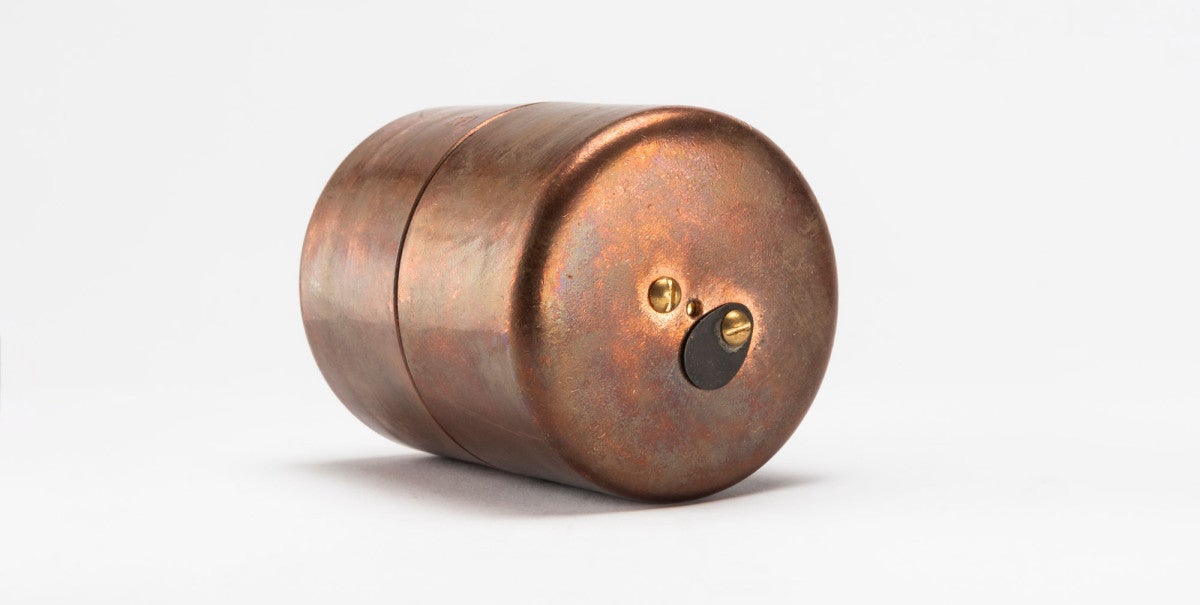
JK: I started out quite modestly, I suppose, by building a camera with an exposure time of 100 years. The idea was to create a surveillance camera where it wasn’t the government monitoring what people were doing or even their neighbors, but rather those most affected by decisions made today, yet least empowered: those not yet born. I initially distributed 100 of these cameras throughout Berlin in 2014. Nobody will see the images for the next 88 years, but people know that pictures are being taken, and that potentially leads to a contextual shift—a change in how people think about gentrification and all the other issues that go into urban development. Eventually I extended my ambition from 100 to a thousand years, because I wanted to consider an environmental perspective. I wanted to reveal what’s happening in the Anthropocene, what’s happening as a result of climate change, mass extinction, and all the rest.
Can you talk more about that aspect of deep time?
JK: I’m really interested in working across generations in terms of how we think about the problems we face. I’m interested in creating a time machine to enable mental time travel. My approach is to set up a camera taking a very long exposure that those in the far future will see, a single exposure that is monitoring the landscape and all that transpires over that thousand-year period. When you encounter a camera like that, you begin to imagine what people might see. That’s the crucial part—you remain in the present, in a position to be able to change the picture, to make the world more aligned with what you would like people to see in the future. My hope is that these cameras can facilitate an intergenerational dialogue, situated everywhere the apparatus is installed, from Lake Tahoe to the Pioneer Valley to the Austrian Alps.
How did you choose this vantage point in Los Angeles?
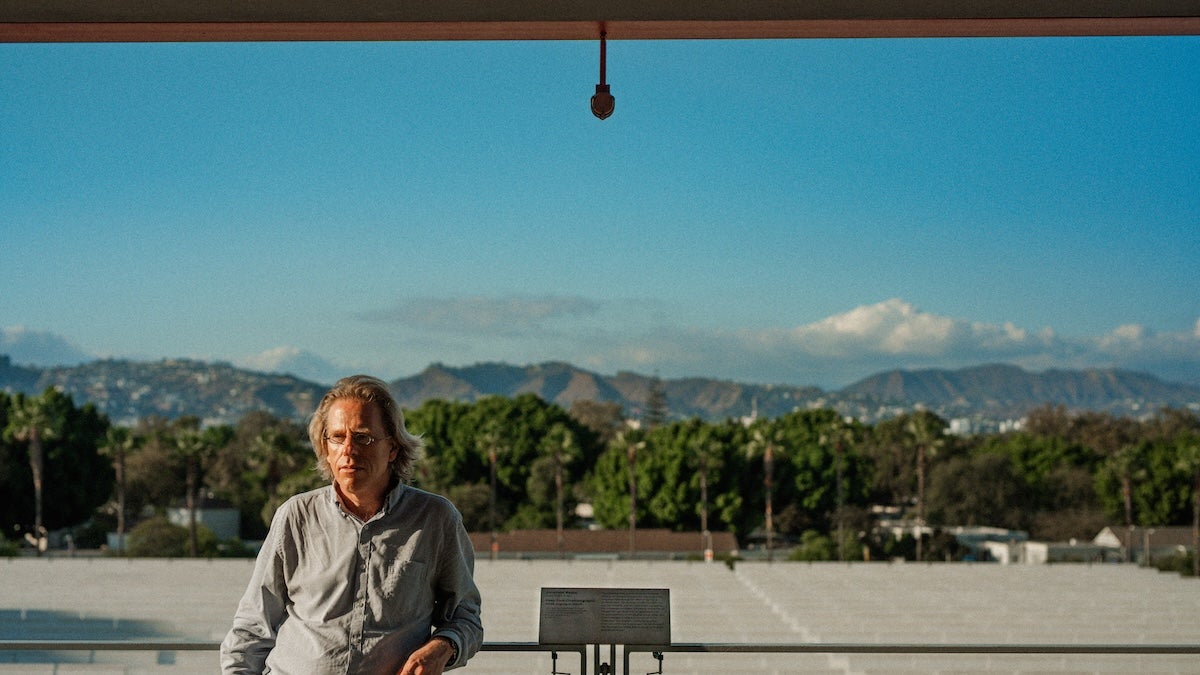
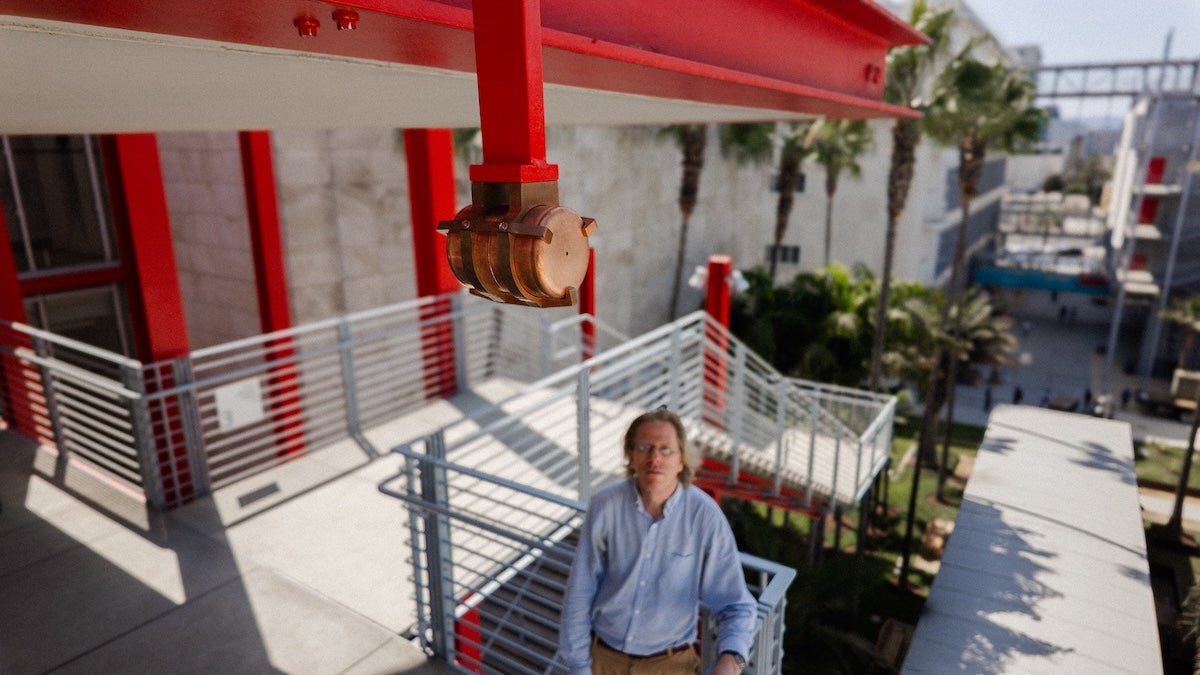
JK: This is where people go to take a selfie. There’s the Hollywood sign and a view of the Hollywood Hills. When I saw the sign, I remembered, “I’m in Hollywood. I’m in Los Angeles. Why am I bothering with stodgy old still photography? I can make a movie.” A movie is basically a bunch of stills shown in sequence. The camera installed at LACMA will produce 10 of those stills in succession, on 10 copper plates. Every thousand years, the museum staff will take the camera out of its custom mount, remove an exposed plate, replace it with a new one, and put the camera back.
Can you talk more about the materials and techniques used to create your work?
JK: I’ve sought to make everything as simple as possible, because when you’re talking about a camera that’s potentially going to operate over a span of 10,000 years, you don’t want someone to forget to change the batteries. You don’t want to rely on digital technology, and even if your system is analog, you really want it to be as simple as possible. And so rather than waiting a thousand years only to find a bug, it seemed wise to look to the past for ideas.
How so?
JK: For the photographic plates, I adapted a Renaissance oil painting technique. I use rose madder, a natural oil pigment that fades very gradually in sunlight. Each plate is rubbed with pumice and then garlic, and then glazed with many layers of paint. The plates are set inside the simplest kind of camera—and the oldest—a camera obscura. Light from outside passes through a pinhole, which projects an image onto the photosensitive surface. Given the size of the aperture, the light level is very low. To maintain the integrity of the pinhole, I drilled it through a plate of 24-karat gold, which will never corrode.
How does this all work together to create the image you might—or hope to—achieve?
JK: As the light passes through the pinhole, everything that you see in front of the camera is recorded. Very gradually, an image is burnt—or bleached—into the red pigment. If all goes according to plan, you’ll end up with a unique print that shows all that transpired, a single image that’s compressing everything captured while the shutter is open for the full thousand-year period. Admittedly, the prints will be disorienting, and all the more so when 10 of them are viewed sequentially in a zoetrope, because the movie will necessarily challenge the conventions of human perception, defying the principles underlying apparent motion. And in any case, most movies don’t take 10,000 years to make. Usually, there isn’t the budget. But that’s because the studios are contracting stars, and those people have expensive lifestyles to maintain, whereas the hills have nowhere to go. They’ll only erode.
What do you think this film will look like in 10,000 years?
JK: What will happen here is anyone’s guess, and that’s partly what interests me. Even the geological processes are unscripted. It’s a documentary. I’m better able to speak to the present, the persistent present, that will endure for hundreds of generations. Ideally, when we stand on the BCAM balcony, we’re looking out at the landscape and thinking about what becomes of space over time. And we’re also considering ourselves in generational terms, in terms of how we relate to our children, our grandchildren, and our parents and grandparents. Ultimately the vision of Deep Time Cinematography is internal as much as it is external.
Jonathon Keats’s Deep Time Cinematography is now on view at LACMA. To make your own camera with a 100-year exposure time, download and print this template from the artist.